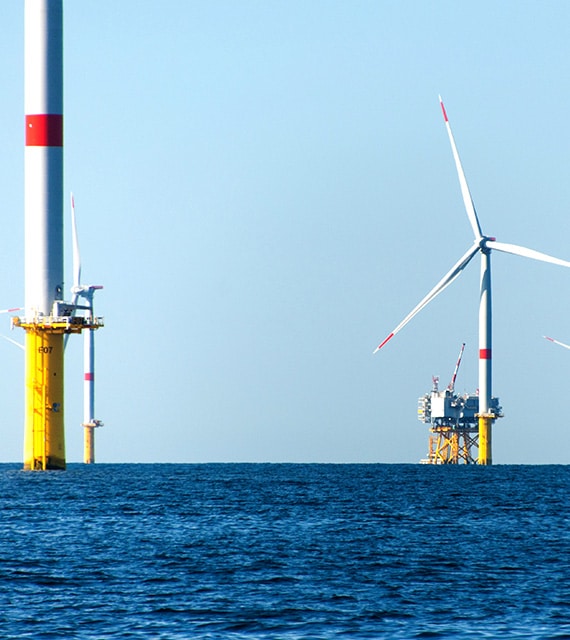
Operation and maintenance of a floating wind farm must be optimised in order to guarantee competitive energy costs and acceptable operational risk. Our Institute is working on this optimisation from various aspects.
In collaboration with our partners, we have established that the use of shared pile anchors would reduce costs by 16 to 33% for a wind farm of 100 turbines. We are now refining our technical and economic analysis and developing tools to enable industry to easily dimension this type of anchor, which is subject to cyclic and multidirectional loadings (MUTANC and MUTANC2 Projects).
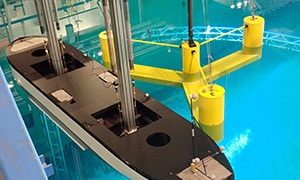
On another note, we have developed a probabilistic short-term metocean forecasting model. An interface fed by the model's outputs allows users to visualise weather windows for offshore operations. At the same time, a methodology for assessing the operability of major component replacement solutions between two floating bodies has been developed and validated through tank testing (FLOWTOM Project).
More recently, we have initiated the creation of an integrated tool to optimise farm architectures during the design phase. Depending on a given geographical location, and based on in-service monitoring strategies, inspections, system redundancy and spare parts management, it enables the quantification and optimisation of availability and maintenance costs (STORM Project).