Research & Development
Projet
BIODHYL
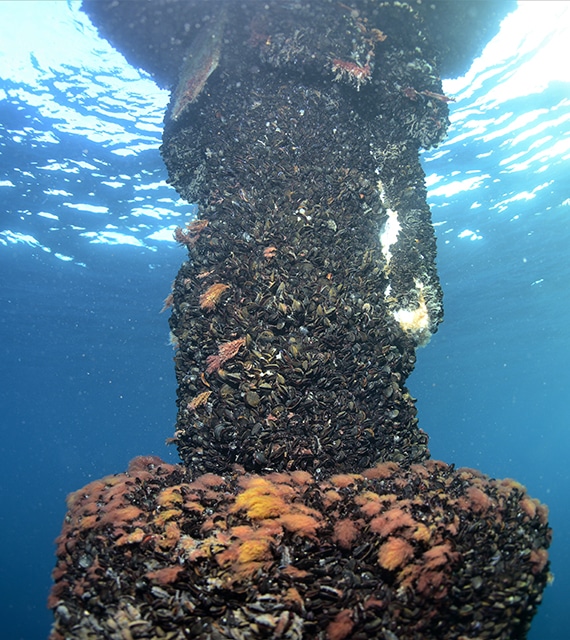
Biofouling characterization and description of hydrodynamic loadings
- Duration: 40 months (2022-2026)
- Budget: €1,900K
Context
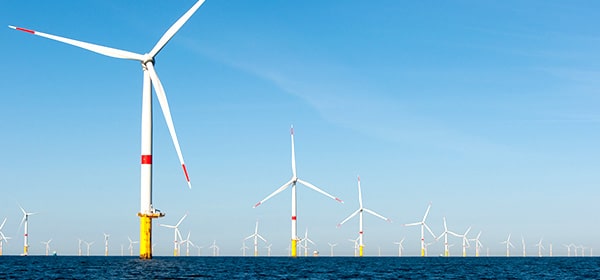
The current trend is to limit or eliminate cleaning operations in farms in order to preserve their reef effect, and thus reduce their environmental impact, while drastically limiting maintenance costs. This is only possible if the phenomenon of biocolonisation is sufficiently understood to be anticipated.
A focus on mooring lines and dynamic cables seems essential, as these key components are presumed to have different hydromechanical behaviour and therefore different wear once colonised. As biocolonisation can vary according to environmental conditions, it is also necessary to characterise biofouling at the sites of future wind, wave and tidal farms.
Objectives
- To gain a better understanding of biofouling, the characteristics of the organisms that make it up, its evolution over time and the environmental parameters that influence it
- To identify the most reliable and robust techniques and protocols for accurately characterising biofouling automatically in order to model its effect
Scientific content
In-situ characterisation of biofouling and study of the influence of parameters such as immersion time, depth, physico-chemical conditions, and site hydrodynamics
Development of methodologies to combine morphological approach and metabarcoding to better characterise biofouling
Definition and characterisation of hydromechanical biofouling groups based on the different fluid-structure behaviours given by the scientific literature and refined by mechanical tests
Building of a generic full scale numerical model of floating wind system including mooring and dynamic cable
State of the art of technologies allowing to automate the recognition and the metrology of biofouling, then benchmark qualification
Expected results
- Increase of the database elaborated in 2018 as part of the
atlas of biofouling along the French coasts - Recommendations on the complementary use of metabarcoding and taxonomic analysis
- Definition of a methodology to characterise the mechanical
properties of biofouling for realistic basin tests - Identification of the components of the mooring lines and
dynamic cables most affected by biofouling - Roadmap for developers to choose technologies for automated biofouling recognition and metrology
Conclusion
Lorem ipsum dolor sit amet consectetur.
Sagittis maecenas aliquam integer lobortis eu dignissim blandit tellus metus. Amet et tristique malesuada mattis pharetra bibendum purus id. Risus in elit ullamcorper ut. Imperdiet amet id feugiat arcu malesuada at ut vulputate condimentum.
Partners
This project is led by France Energies Marines.
Funding
This project received French State funding managed by the National Research Agency under the France 2030 investment plan (ANR-10-IEED-0006-34). It also received financial support from the Brittany, Occitanie, Pays de La Loire et SUD Provence-Alpes-Côte d’Azur.
Accreditation
This project is certified by the maritime cluster Pôle Mer Bretagne Atlantique.
Pour aller plus loin
Ajoutez votre titre ici
Lorem ipsum dolor sit amet, consectetur adipiscing ut elit tellus
Ajoutez votre titre ici
Lorem ipsum dolor sit amet, consectetur adipiscing ut elit tellus
Ajoutez votre titre ici
Lorem ipsum dolor sit amet, consectetur adipiscing ut elit tellus