Modelling and monitoring of polyamide mooring lines
Duration: 42 months (2020-2023)
Budget: €2,000K
Context
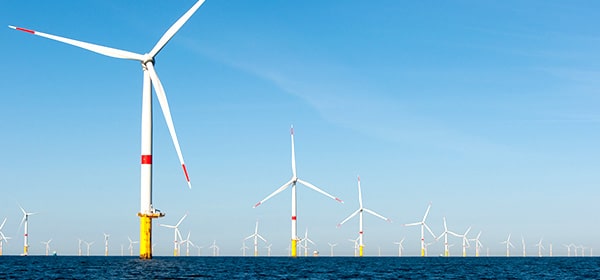
Mooring systems using polyamide ropes are a promising technical and economic solution for future floating wind farms. Polyamide lines can be used to reduce maximum tensions, absorb the loads transmitted to the float and reduce the footprint of the mooring on the ground. As the long-term behaviour of this type of synthetic fibre is not well known, its qualification for a period corresponding to that of the operation of a wind farm (20 to 25 years) is a major challenge.
Objective
To develop tools for modelling the mechanical behaviour of nylon fibre lines and appropriate long-term monitoring instruments, based on an in-depth understanding of degradation mechanisms
Main achievements
Improvement and validation of a nylon behaviour law established during a previous project (POLYAMOOR from 2017 to 2020)
Long-term laboratory creep tests
Fatigue tests, X-ray tomography analysis of ropes, use of the self-heating method
Development of a 3D mesoscale finite element model of a subrope
Raising the level of technological maturity of various innovative sensors: elongation (wire, ultrasound, fibre optics), pressure, acoustic emission
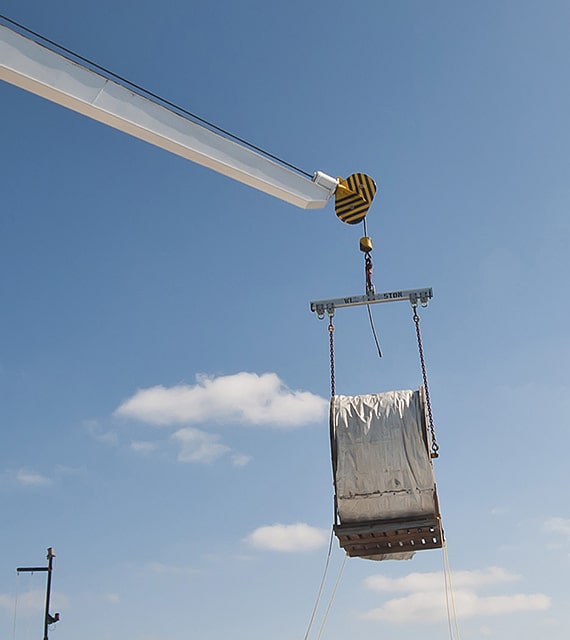
Design, assembly and deployment at sea of a demonstrator capable, on a reduced scale, of representing the forces generated by a floating wind turbine
Sea trials to validate the behaviour law and some of the sensors developed
Main outputs
Visco-elasto-plastic behaviour law validated, for a representative scale, with laboratory and sea trials
Creep curve developed with several years of data showing the validity of a prediction based on test results lasting a few hours
3D mesoscale finite element model of a subrope
Reliable acquisition and processing methodology for in-service monitoring
At sea demonstrator for testing mooring components and sensors in offshore conditions
POLYAMOOR and then MONAMOOR have led to significant advances in innovative mooring solutions. They confirmed that the lifespan of polyamide is compatible with that of a commercial farm. Robust modelling tools for the short- and long-term behaviour and fatigue of synthetic lines have been developed. A modelling law and innovative sensors were validated during sea trials.
Partners
This project was led by France Energies Marines and Ifremer.
Funding
This project received French State funding managed by the National Research Agency under the France 2030 investment plan (ANR-10-IEED-0006-34). It also received financial support from the Brittany, Pays de La Loire and SUD Provence-Alpes-Côte d’Azur regions.
Accreditation
This project is certified by the maritime clusters Pôle Mer Bretagne Atlantique and Pôle Mer Méditerranée.
Pour aller plus loin
Ajoutez votre titre ici
Lorem ipsum dolor sit amet, consectetur adipiscing ut elit tellus
We use cookies to personalize content, provide social media features, and analyze our traffic. We also share information about your use of our site with our analytics partners. You can change your preferences at any time. For more information, please see our Privacy Policy and Cookie Policy.