Research & Development
Projet
POLYAMOOR
Durable and flexible polyamide moorings for offshore renewable energies
- Duration: 46 months (2017-2020)
- Budget: €825K
Context
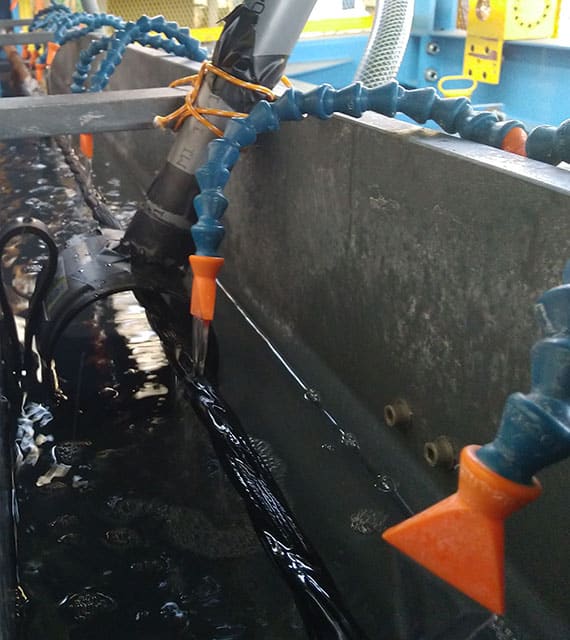
Mooring systems used for floating wind turbines differ significantly from those used in the oil & gas sector due to elevated dynamics in shallow waters. The challenge is to be able to maintain a floater in an extreme environment by limiting the forces transmitted by the mooring lines as well as limiting the maximum offset of the floater to which the export cable is connected. One envisaged solution is to use nylon mooring lines capable of absorbing the involved forces but whose behaviour is highly non-linear and poorly understood in cases of long service life.
Objective
- To characterise in detail the dynamic and long-term behaviour of nylon mooring lines in order to develop standards accordingly
Main achievements
Identification of a nylon cable configuration compatible with the lifetime of a floating wind farm (20-25 years)
Identification of a generic visco-elasto-plastic rheological scheme
Analytical formulations of the different rheological blocks adapted to nylon, then calibration and validation of these formulations by specific test sequences
Identification of a simple long-term creep law (period > 1 year)
Feasibility of an accelerated self-heating life prediction method
Main outputs
- Database of small-scale stress and elongation for nylon behaviour characterisation
- Database of stress and elongation for subcord fatigue tests
- Analytical model of the visco-elasto-plastic behaviour of nylon and proprietary module of this behaviour law in the commercial software DeepLinesTM
- Analytical formulation and test protocol for accelerated qualification of nylon by self-heating
- Analytical formulation of long-term nylon creep
- Update of the guidance note for the certification of synthetic lines used in offshore environments (BV NI432)
Conclusion
POLYAMOOR has identified a behavioural law that closely reproduces the instantaneous behaviour of nylon. A long-term creep behaviour law has been identified. Creep at different loading rates and its effect on the behaviour law will be studied in the MONAMOOR project.
The service life objectives are achieved with a dedicated rope construction and the use of a specific polymer coating. The performance durability of this coating remains to be qualified. The results have led to the updating of a recommendation note for the certification of synthetic lines used in the offshore environment (BV NI432).

Partners
This project was led by France Energies Marines and Naval Energies.
Funding
This project received French State funding managed by the National Research Agency under Investments for the Future Programme (ANR-10-IEED-0006-16).
Accreditation
This project was certified by the maritime cluster Pôle Mer Bretagne Atlantique.
Pour aller plus loin
Ajoutez votre titre ici
Lorem ipsum dolor sit amet, consectetur adipiscing ut elit tellus
Ajoutez votre titre ici
Lorem ipsum dolor sit amet, consectetur adipiscing ut elit tellus
Ajoutez votre titre ici
Lorem ipsum dolor sit amet, consectetur adipiscing ut elit tellus