Research & Development
Projet
Consideration of biofouling using quantification protocols useful for engineering
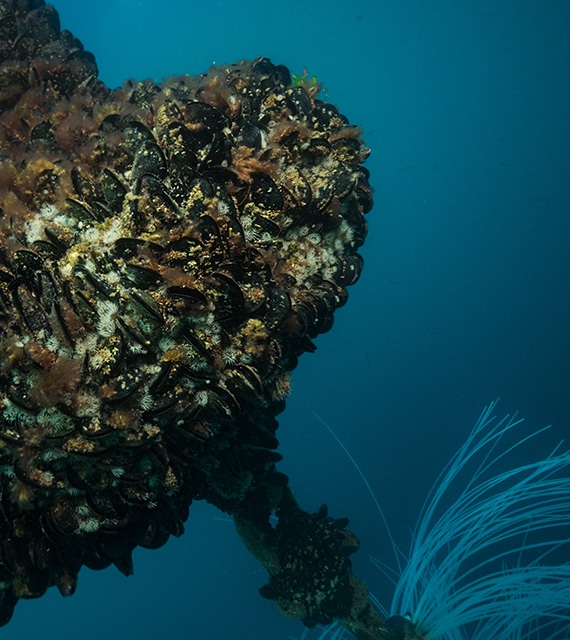
Biocolonisation of submerged elements, also known as biofouling, could have a significant impact on mooring lines and dynamic cables. It also leads to a modification of the marine environment in which the structures are deployed, notably via the reef effect.
However, biocolonisation is not fully understood, especially if we consider the very dynamic, shallow (< 200 m) and offshore sites, which are characteristic of the areas where offshore renewable energy recovery systems are installed. Biofouling is therefore a crucial parameter to be quantified and qualified in order to be properly taken into account.

ABIOP+ has highlighted the high spatial and temporal variability of the
communities of organisms making up the biofouling on offshore sites. It
also led to the development of high-performance protocols and numerical tools to better take into account the impact of the biocolonisation
of submerged components in the design studies of systems and farms.
Finally, the project has enabled the identification of an innovative antifouling solution validated for use in static and dynamic conditions.
This project was led by France Energies Marines.
This project received French State funding managed by the National Research Agency under the France 2030 investment plan (ANR-10-IEED-0006-34). It also received financial support from Pôle Mer Méditerranée, and Brittany, La Réunion, Normandy, Pays de La Loire and SUD Provence-Alpes-Côte d’Azur regions. This project also benefited the technical support from the Direction Interrégionale de la Mer Nord Atlantique Manche Ouest.
This project is certified by the maritime clusters Pôle Mer Méditerranée.
Lorem ipsum dolor sit amet, consectetur adipiscing ut elit tellus
We use cookies to personalize content, provide social media features, and analyze our traffic. We also share information about your use of our site with our analytics partners. You can change your preferences at any time. For more information, please see our Privacy Policy and Cookie Policy.