The Board of Directors of France Energies Marines has approved the launch of four new research and innovation projects involving 33 public and private partners. Representing a total investment of nearly €10 million, these initiatives aim to provide offshore wind stakeholders with new methodologies and solutions to enhance installation reliability, reduce operating costs and improve integration within the marine environment. The projects will be launched in autumn 2026.
Addressing the sector's needs
France Energies Marines is launching four new research and innovation projects to address several key technical, environmental and societal challenges faced by the offshore wind sector. Defined in consultation with the Institute’s industrial members and partners, these projects respond to operational needs identified by the industry both in France and internationally. They will focus on strategic issues for both fixed-bottom and floating offshore wind developments: assessing cumulative impacts on marine ecosystems, the durability of polyamide mooring lines, biofouling and biocolonisation of offshore structures, and the characterisation of atmospheric turbulence using lidar technologies.
Through this new portfolio of projects, detailed below, France Energies Marines reaffirms its role as a catalyst for research and innovation in support of the offshore wind industry, fostering collaboration between academic institutions, research centres and industrial stakeholders.
Four projects launched this fall
ACT NOW – Improving the assessment of cumulative impacts from offshore wind farms
The ACT NOW project aims to make operational several modelling tools developed by France Energies Marines to assess the cumulative effects of offshore wind farms and other human activities on marine ecosystems. At the end of the project, these models, resulting from more than ten years of research, will be transferred to industry stakeholders in the form of methodologies and software solutions that can be used in environmental assessments and decision-support processes.
GLAMOOR – Investigating the degradation of synthetic fibres for permanent mooring applications
Mooring lines are required to maintain floating systems in position under demanding environmental conditions. Synthetic fibres are increasingly favoured over steel chains due to their low weight, ease of installation and damping properties, which reduce loads on floating structures. Among these materials, polyamide 6 (PA 6) has proven to be a promising candidate. While the series of R&D projects initiated since 2017 has identified the main failure mechanisms affecting PA 6 ropes, questions remain regarding their long-term degradation in seawater. The effects of the marine environment on the mechanical properties and fatigue resistance of these ropes also need further investigation. Addressing these challenges is the core objective of the GLAMOOR project.
QUANTUM – Better characterising and anticipating biocolonisation on offshore wind turbines
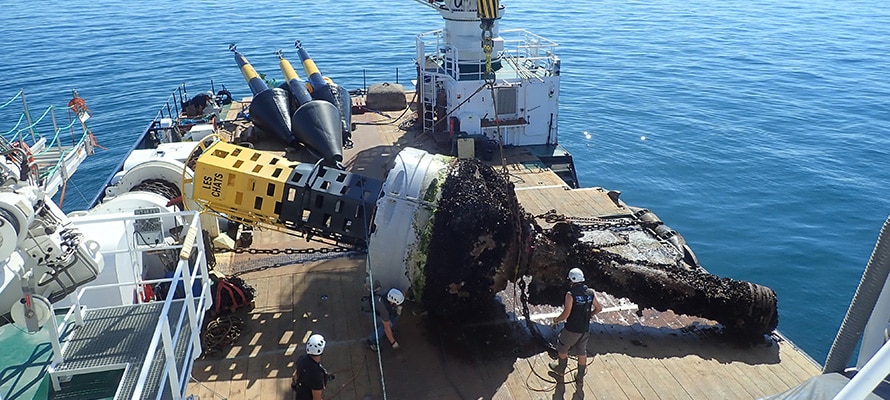
Any structure submerged in the sea is gradually colonised by living organisms. This phenomenon, known as biocolonisation, can affect submerged wind turbine components while also creating an artificial reef effect. To improve monitoring of these processes, the QUANTUM project will develop standardised protocols for monitoring biocolonisation within offshore wind farms and will establish quantitative databases. Comparisons of methodologies and clear recommendations will be provided to industry stakeholders to help adapt monitoring programmes to local contexts and infrastructure types. An automated image analysis method will also be developed to detect and identify species present on offshore structures. Finally, an in situ experiment will be conducted to assess the ecological relevance of eco-designed structures intended to enhance the reef effect associated with offshore wind farms.
TULIP – Reliable and accurate measurement of turbulence intensity using fixed and floating lidars
Atmospheric turbulence plays a crucial role in assessing the forces acting on wind turbines and in estimating energy production. Accurate characterisation is therefore essential. TULIP forms part of a series of projects undertaken since 2021 on measuring turbulence intensity using lidar systems, whose deployment costs are significantly lower than those of sensors mounted on offshore meteorological masts. Obtaining turbulence data from lidars remains challenging, particularly in the case of floating platforms. The project will therefore develop software capable of deriving turbulence intensity measurements from both fixed and floating lidar systems, with a level of accuracy compliant with industry standards and a degree of confidence acceptable to offshore wind project financiers.