Understanding and managing biofouling remains a major challenge for the offshore renewable energy sector. Progress in this area is often hampered by a lack of offshore data collected over a long period.
As part of the BIODHYL joint industry project, a multi-year monitoring programme was carried out at various sites in the Atlantic and the Mediterranean, at different depths. This experiment is remarkable for its nature and duration. It enabled the collection of previously unrecorded data and led to major findings for industry.
Biofouling: a two-fold challenge for offshore renewable energies
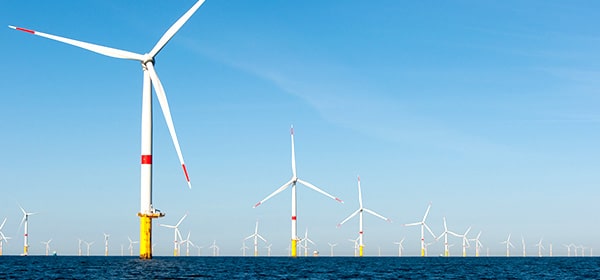
The development of offshore renewable energy (ORE), particularly floating offshore wind, is leading to the large-scale deployment of artificial structures at sea.
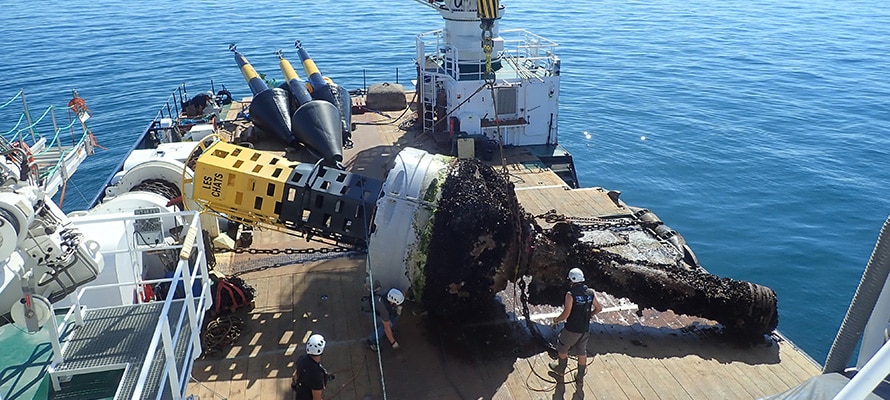
Once installed, these structures are rapidly inhabited by marine flora and fauna (sedentary organisms and mobile fauna). This process, known as biocolonisation, poses a number of challenges.
The attachment of organisms, called biofouling, can increase fatigue, accelerate material degradation and call into question the design assumptions for critical components, in particular for floating offshore wind with mooring lines and dynamic power cables.
Although they promote biodiversity (a phenomenon known as the reef effect), artificial offshore structures also raise questions about their long-term ecological impacts.
An innovative protocol and a groundbreaking monitoring for biocolonisation
The BIODHYL R&D project (2022–2026), which concluded on 28 April this year, led to the development of an innovative protocol for measuring biofouling on synthetic mooring lines and dynamic cables.
A multi-year monitoring programme of biofouling was carried out at different sites in the Atlantic and the Mediterranean. This at-sea experiment is remarkable for its nature and duration.
Indeed, it combines long-term observations (up to 4 years) in the subsurface (–2 m) with observations representative of floating offshore wind turbine moorings over a shorter period, at different depths. It enabled the collection of unprecedented data and led to several major findings.
Key results for the sector
- It appears that a minimum 2-year deployment of representative materials is necessary to characterise in detail the nature and dynamics of biocolonisation at a site.
- The multi-site nature of the study and the collection of data at different depths have made it possible to obtain values that are more relevant to the design of floating wind turbines than the main standards currently in use and which are based on experience gained in the North Sea.
- The main factors influencing the composition and development of biofouling (such as depth, pH or sea current velocity) were identified on the basis of various parameters measured in situ and a comparison with data from numerical models. A methodology was developed to measure their influence on the dynamics of biofouling.
- An integrative taxonomic approach, combining morphological and genetic analyses, has been tested and proven effective: it provides a better understanding of the diversity of biofouling and mobile species, whilst detecting non-native species.
- The detection of fish DNA in biofouling highlights the value of this type of analysis for the reef effect understanding.
- A roadmap has been drawn up to validate innovative sensors designed to measure biofouling remotely. It will be implemented in a future project.