

What topics do you work on at France Energies Marines?
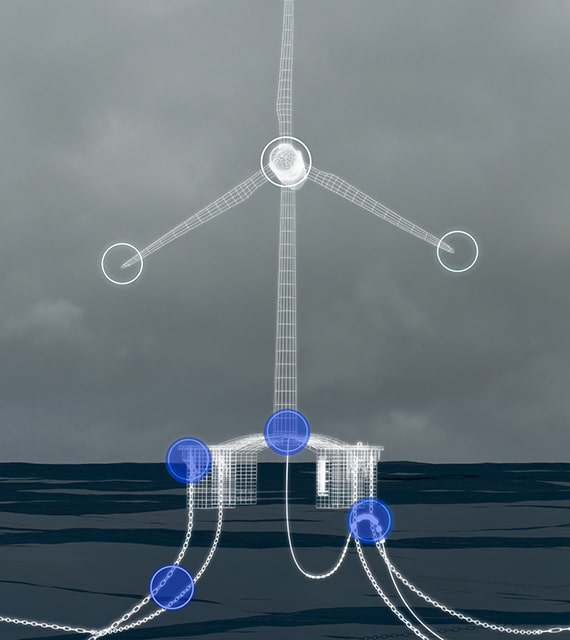
I’m currently involved in two collaborative R&D projects focusing on the development of a digital twin of a floating wind turbine: SUBSEE 4D and DIONYSOS. When I first joined France Energies Marines about a year ago, I worked mainly on the graphic interface to display the results from the floater and mooring line fatigue monitoring system. After that, I got started on building a digital model using multiphysics tools capable of taking into account parameters relating to the turbine’s structure, aerodynamics, control system and hydrodynamics. This was followed by the model validation phase then mathematical work to correlate the simulated and field data.
What do you enjoy most about your work?
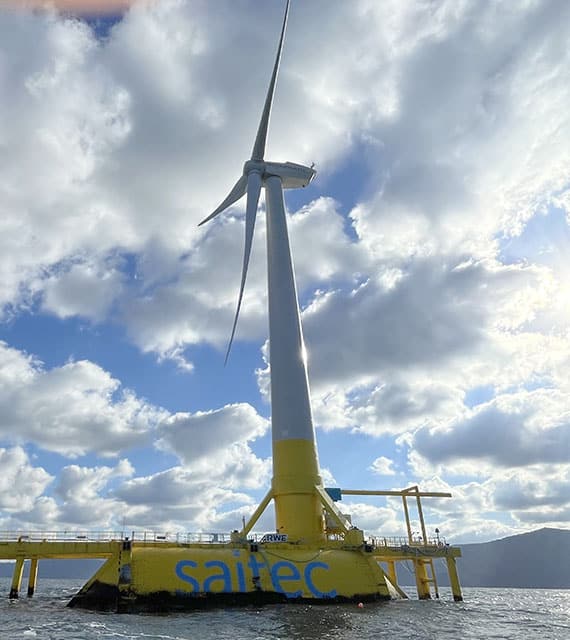
As part of DIONYSOS, a full-scale floating wind turbine operating off the coast of Norway is to be instrumented with various sensors, thanks to which we will be able to collect field data. This groundbreaking study is really stimulating. The France Energies Marines team is growing steadily, boosting the digital twins focus. We nevertheless have quite a small number of staff, meaning that we need to be curious and multidisciplinary, while regularly communicating with our various partners. For example, I’m currently working with a post-doctoral researcher from IMT Atlantique, specialised in neural networks, to help her apply her scientific approach to the context of floating offshore wind. Another strength lies in the fact that we have considerable internal computing resources and access to a GENCI (Grand Équipement National de Calcul Intensif) supercomputer, which is noteworthy for an organisation of our size. This means that several simulations can be run simultaneously.
Do you work on other tasks on top of these two projects?
Yes, I help to represent France Energies Marines within the broader scientific community by taking part in two mathematical research groups: UQSay which focuses on uncertainty quantification and the design and analysis of computer experiments, and GdR MASCOT-NUM on stochastic methods for the analysis of numerical codes.