Effective monitoring strategies to identify and evaluate effects of offshore wind farms and their export cables on fish communities
Duration: 36 months(2021 - 2024)
Budget: €2,363K
Motivation and background
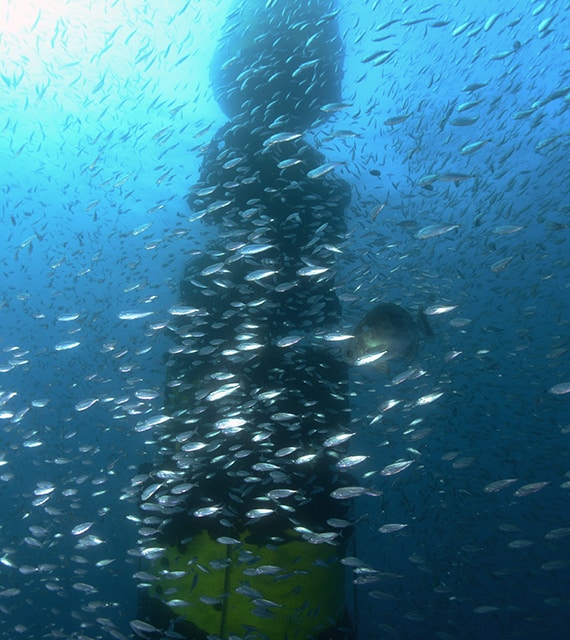
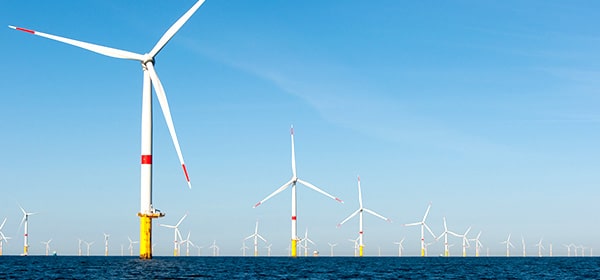
In France, the first offshore wind farm should be operational by 2022 and will require full-scale experimentation and monitoring of fish communities to detect and quantify the potential effects of such installations. Multi-gear experimental fishing, which is traditionally used in regulatory impact assessment of offshore wind farms on fish, is not sufficient to achieve this objective and address societal concerns. Site access regulations and offshore wind farm specificities will also limit the capacity to implement certain monitoring methods. There is therefore a need for the development of effective methodological strategies to monitor fish populations. Advanced indirect approaches, such as acoustic telemetry, associated with a robust sampling design, provide an alternative to traditional monitoring surveys for offshore wind farm projects.
Objective
To develop a long-term monitoring approach capable of detecting effects of both fixed and floating offshore wind farms and their export cables on fish communities
Main achievements
Deployment of acoustic telemetry networks in four wind farms at different stages of development
Monitoring movements of more than 300 individuals of 12 species of fish and crustaceans and their use of offshore wind farms
Recommendations on the implementation of acoustic telemetry monitoring within a wind farm at different spatial scales
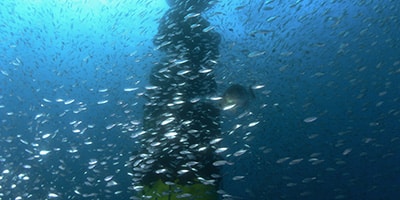
Demonstration of the relevance of a combined approach for assessing the reef effect of wind farms on fish populations
Main outputs
Database of indivduals’ detections in four offshore wind farms
Compilation of regulatory fisheries monitoring for offshore wind farms Scripts and algorithms for managing, processing and visualising acoustic telemetry data
Recommendations for implementing acoustic telemetry monitoring at different spatial scales
Summary of existing methods for monitoring fish populations and recommendations on the implementation of complementary methods
FISHOWF has demonstrated the relevance of acoustic telemetry for monitoring the effects of offshore wind farms on fish and fill important gaps on ecological knowledge of studied species. The project also highlighted the value of using complementary methods to monitor the reef effect of offshore wind farms on fish populations.
Partners
This project is led by France Energies Marines
Funding
This project receives French State funding managed by the National Research Agency under the France 2030 investment plan (ANR-10-IEED-0006-34). It also receives financial support from Université de Bretagne Occidentale, SUD Provence-Alpes-Côte d’Azur region and Bretagne region.
Accredidation
This project has been certified by the maritime cluster Pôle Mer Méditerranée.
We use cookies to personalize content, provide social media features, and analyze our traffic. We also share information about your use of our site with our analytics partners. You can change your preferences at any time. For more information, please see our Privacy Policy and Cookie Policy.