Research & Development

Projet

FISHOREMAN

Towards an improvement in the representation of fisheries in the ecosystem approach using social, economic and cultural basis

Motivation & background

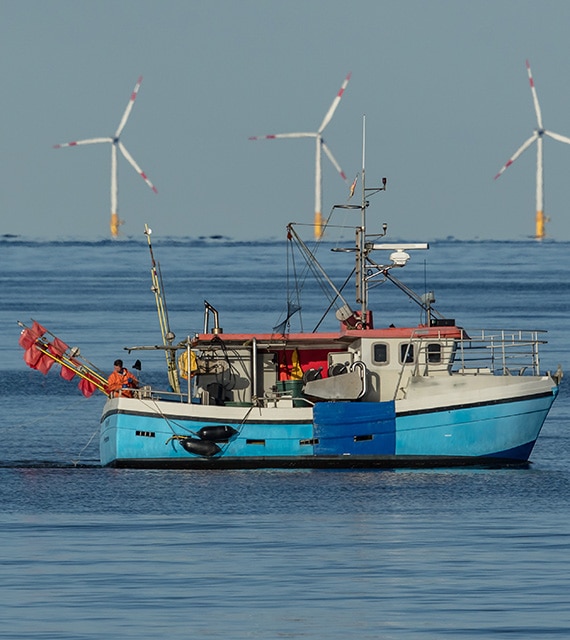
The quantification of cumulative impacts between offshore wind farms (OWF) development and fisheries relies on numerical models based on schematic representation of fisheries dynamics. A critical limitation lies in the simplicity of this representation which do not consider (or oversimplify) cultural and socio-economic dimensions in fishers’ behavior. These simplifications, in turn, pose two significant challenges. On one hand, the inaccurate representation of fishers’ responses to the deployment of offshore wind farms introduces significant uncertainty into ecosystem models and compromises the accuracy of simulations. On the other hand, the lack of stakeholder participation in the development of the models reduces confidence in their forecasts. Involving both the fishing sector and OWF developers in co-constructing models and scenarios is thus crucial to gain realism and foster a higher trust on the capacities of such tools.

FISHOREMAN Project

Objectives

  • To enhance our understanding of fishing fleets by analysing the cultural and socio-economic drivers influencing their activity and quantifying their vulnerability to OWF
  • To build a flexible fleet dynamic modelling tool to simulate cumulative impacts associated with OWF under multiple co-constructed scenarios with a better representation of the fishing fleets

Work planned

1. Profile of a set of fishing fleets

• A methodology for the multi-criteria definition of a set of fleets with contrasted characteristics in two façades: Eastern English Channel and Gulf of Lion
• Socio-economic and cultural analysis of these fleets
• Fishing-style analysis, based on an integration of quantitative and qualitative methods

2. Socio-economic vulnerability of fishing fleets to the deployment of offshore wind farms

• Analysis of cultural and socio-economic vulnerability of the selected fleets to the deployment of offshore wind
• Co-construction of scenarios for the cohabitation between fishers and the deployment of offshore wind

3. Prediction of fishing fleet dynamics in the context of the deployment of offshore wind farms

• Development of a fleet-specific dynamic model including environmental, economic, social, and cultural factors gathered in WP2 and WP3 to better represent fishing activities in the Eastern English Channel
• Development of a flexible module to integrate fleet dynamics into different food-web or ecosystem models


4. Simulation of cumulative impacts associated with offshore wind farms through different cohabitation scenarios

• Quantitative translation of the scenarios built in WP3 in the Eastern English Channel for ecosystem modelling
• Simulation of the multiple scenarios with cumulative impacts (OWF reef and reserve effects, climate change…)

Deliverables

  • A methodology for the fleet definition and interview guidelines
  • Fishers’ portraits and conceptual representations of different fishing styles
  • Synthetic sheets for each fishing fleet integrating their main features and their economic and socio-cultural vulnerability
  • Co-definition of multiple scenarios of co-use of maritime space by fishing fleets and OWF in the Eastern English Channel and the Gulf of Lion
  • A fishing fleet dynamic model including environmental, economic, social, and cultural factors for each selected fleet in the Eastern English Channel
  • A flexible module to integrate fleet dynamics in ecosystem or food-web models
  • Simulation of the co-constructed scenarios

Conclusion

Lorem ipsum dolor sit amet consectetur.

Sagittis maecenas aliquam integer lobortis eu dignissim blandit tellus metus. Amet et tristique malesuada mattis pharetra bibendum purus id. Risus in elit ullamcorper ut. Imperdiet amet id feugiat arcu malesuada at ut vulputate condimentum.

Partners

This project is led by France Energies Marines

Logo France Energies Marines
Logo Ifremer
Logo Université de Bretagne Occidentale
Logo Natural Power
Logo RWE
Logo Pôle Mer Méditerranée
Logo CRPMEM Occtanie
Logo EDF Power Solutions
Logo Mediterranean Institute of Oceanography (MIO)
Logo TotalEnergies
Logo Skyborn

Funding

This project receives French State funding managed by the French National Research Agency under the France 2030 investment plan. It is also supported by the Sud Provence Alpes Côte d’Azur, Bretagne and Occitanie regions.

Logo France 2030
Logo Région SUD Provence-Alpes-Côte d'Azur
Logo Région Bretagne
Logo Région Occitanie

Accreditation

This project has been certified by the maritime clusters Pôle Mer Bretagne Atlantique and Pôle Mer Méditerranée.

Logo Pôle Mer Bretagne Atlantique
Logo Pôle Mer Méditerranée

Pour aller plus loin

Ajoutez votre titre ici

Lorem ipsum dolor sit amet, consectetur adipiscing ut elit tellus

Ajoutez votre titre ici

Lorem ipsum dolor sit amet, consectetur adipiscing ut elit tellus

Ajoutez votre titre ici

Lorem ipsum dolor sit amet, consectetur adipiscing ut elit tellus

Know more

Would you like to know more ?