Research & Development
Project
DRACCAR-COBHYS
Structural behaviour – Benthos & biofouling – Hydrosedimentary processes
- Duration: 60 months (2023-2028)
- Budget: €5,100K
Context
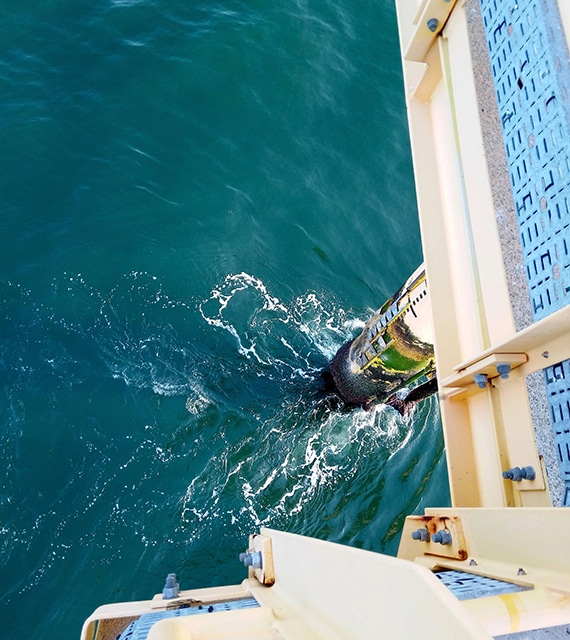
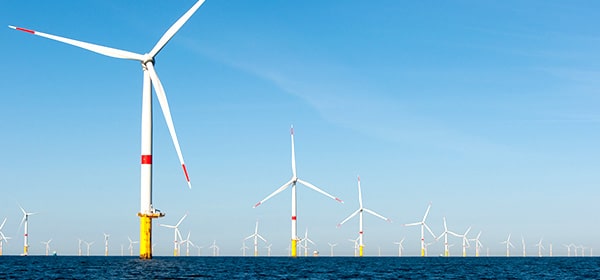
The long-term acquisition of data at sea remains a crucial research challenge for the development of offshore wind farms. The use of a met mast located off Fécamp makes it possible to deploy cutting-edge instrumentation and develop innovative monitoring protocols.
Objectives
- To optimise the design of future bottom-fixed offshore wind turbines
- To characterise the role of the reef effect of a wind turbine
Scientific content
Structural behaviour
• Implementation of an experimental protocol to capture wave parameters and the pressures induced on the mast, determination of hydrodynamic loads
• Numerical modelling of the loadings applied to the mast, validated by in situ measurements (strain gauges, accelerometers)
• Comparison of the results obtained in situ with those of tests carried out on a model (1/75th) under different conditions, then comparison with numerical simulations
• Characterisation of the temporal structural behaviour, integrating the various damping factors involved (structural, aeraulic, and hydraulic)

Benthos & biofouling
• Sampling in winter and late summer from various ecosystem compartments (phytoplankton and zooplankton, soft and hard substrate benthos, suprabenthos, demersal fish)
• Sorting, determination and isotopic analysis of samples
• Analysis of stomach contents of demersal fish to quantify prey-predator relationships
• Immersion of plates around the mast according to a distance gradient in and out of the current trench
Hydrosedimentary processes
• Deployment during the winter of 3 cages equipped with sensors to study the effects of wakes on hydrodynamics, particle transport in the water column and bottom scavenging
• Bathymetric campaigns using towed current measurements and sediment sampling in the water column and on the seabed
• Comparison of in situ measurements with numerical models
• Deployment of a bottom structure outside the influence of the mast to measure wave heights, study wave propagation from the open sea to the coast and compare with numerical models
Expected results
Structural behaviour
Calibrated numerical model for accurate assessment of hydrodynamic-structure interactions
Data on the longer-term ageing of the structure (foundation, lattice)
Benthos & biofouling
Determining the role of biofouling in the food web
Characterisation of the role of structure in larval dispersal and colonisation dynamics in flora and fauna
Hydrosedimentary processes
Qualified tool for numerical modelling of hydrosedimentary processes
Quantification of sediment availability
Conclusion
Lorem ipsum dolor sit amet consectetur.
Sagittis maecenas aliquam integer lobortis eu dignissim blandit tellus metus. Amet et tristique malesuada mattis pharetra bibendum purus id. Risus in elit ullamcorper ut. Imperdiet amet id feugiat arcu malesuada at ut vulputate condimentum.
Partners
This project is led by Universités de Caen and Le Havre Normandie.
Funding
This project is supported by the Normandy region through funding from the European Regional Development Fund. It benefits from government funding managed by the Agence nationale de la recherche as part of the France 2030 investment plan.
Labellisation
Lorem ipsum dolor sit amet consectetur. Sagittis maecenas aliquam integer lobortis eu dignissim blandit tellus metus. Amet et tristique malesuada mattis pharetra bibendum purus id. Risus in elit ullamcorper ut. Imperdiet amet id feugiat arcu malesuada at ut vulputate condimentum.
Pour aller plus loin
Ajoutez votre titre ici
Lorem ipsum dolor sit amet, consectetur adipiscing ut elit tellus
Ajoutez votre titre ici
Lorem ipsum dolor sit amet, consectetur adipiscing ut elit tellus
Ajoutez votre titre ici
Lorem ipsum dolor sit amet, consectetur adipiscing ut elit tellus