Research & Development

Projet

2C MORE

Climate change impacts on offshore wind energy

Motivation & Background

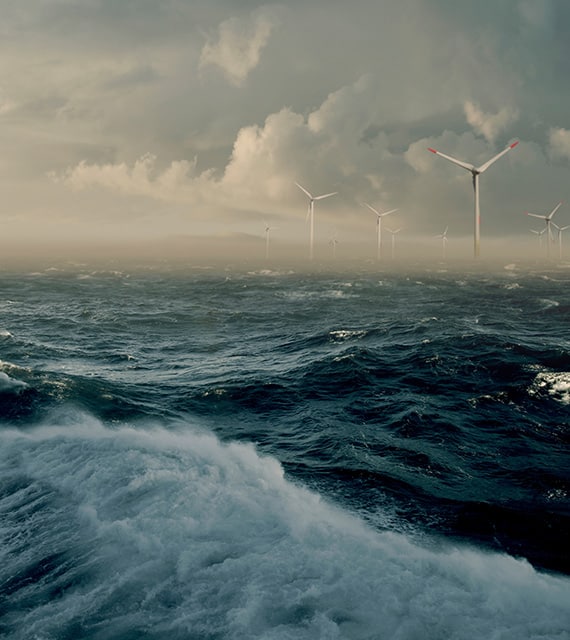
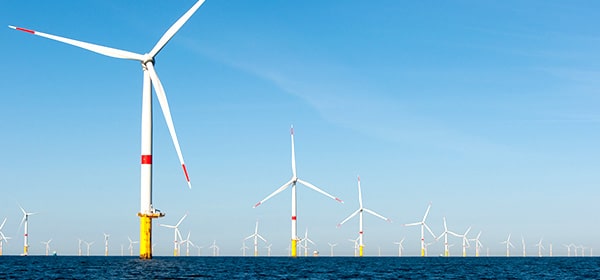
In France, the cumulative offshore wind capacity is expected to reach 45 GW by 2050. However, will offshore wind farms remain profitable in 2050, and at the end of their lifespan, in 2080 or 2100 due to climate change?

Over the next few decades, wind resources might evolve and differ from current estimates derived from hindcast databases, leading to changes in wind energy production and impacting the business plans established during their creation. Will these changes be positive or negative for the offshore wind industry?

Climate change could also affect the length and intensity of seasons, impacting the balance between supply and demand in the energy sector. Will there be compound events of cold waves and wind droughts that could threaten the energy balance?

The intensity and frequency of extreme metocean events may change during the next decades, affecting the design of all wind farms components. Is it possible to assess the impacts of these developments, due to climate change, in terms of design conditions?

Projet 2C MORE

Objective

  • To assess the climate change impacts on the offshore wind industry, focusing on the evolution of wind power and modifications of design conditions, with an evaluation of associated uncertainties

Scientific work planned

Impacts of climate change on atmospheric variables

• Evaluation of wind climate models over historical period using reanalyses and in situ observations, emphasizing diurnal, seasonal cycles, inter-annual variability, complete distributions, and extremes
• Study of climate projections to assess the future impacts of climate change on key variables for offshore wind, including the evolution of compound events affecting the grid


Impacts of climate change on ocean variables

• Benchmark of wave climate datasets over historical period
• Implementation of a new global wave model in climate mode based on WAVEWATCH III®
• Use of super-resolution methods for coastal wave modelling using machine learning on a study site
• Determination of the impact of climate change on wave parameters and other oceanic parameters

Mathematical methods for climate sciences

• Analysis and application of statistical downscaling and bias correction methods for all atmospheric and oceanic variables
• Extreme analyses of metocean parameters in a climate change context
• Development of uncertainty quantification methods using tools, like data assimilation methods or machine learning algorithms

Offshore wind applications of climate change impacts

• Assessment of the producible output evolution
• Study on offshore wind turbines design calculations, including foundation or floater
• Quantification of the coastline evolution and of its implications for the landfall zones of power cables

Transfer to industry

• Development of an on-line platform
• Integration of tools and case studies

Expected deliverables

  • Improvement of knowledge on metocean evolutions in the future (2050 and 2100 horizon), with associated uncertainties evaluation
  • Advanced mathematical approaches for regional climate data bias correction, studies of extreme weather events and quantification of uncertainties
  • New wave climate datasets
  • Recommendations for adapting the design of offshore wind turbine systems to future climatic conditions based on structural sensitivity analysis
  • Recommendations for the resilience of power cables based on the study of the effects of climate change on their design and durability in the landfall zone

Conclusion

Lorem ipsum dolor sit amet consectetur.

Sagittis maecenas aliquam integer lobortis eu dignissim blandit tellus metus. Amet et tristique malesuada mattis pharetra bibendum purus id. Risus in elit ullamcorper ut. Imperdiet amet id feugiat arcu malesuada at ut vulputate condimentum.

Partners

This project is led by France Energies Marines and RTE.

Logo France Energies Marines
Logo RTE
Logo Bureau de Recherches Géologiques et Minières
Logo Centrale Méditerranée
Logo Ecole Nationale des Ponts et Chaussées
Logo EDF
Logo Ifremer
Logo Institut des Géosciences de l'Environnement
Logo IMT Atlantique
Logo Institut Pierre-Simon Laplace
Logo Météo France
Logo SHOM
Logo TotalEnergies

Funding

This project receives French State funding managed by the National Research Agency under the France 2030 investment plan (ANR-10-IEED-0006-34). It also receives financial support from the Brittany, Normandy, and SUD Provence-Alpes-Côte d’Azur regions.

Logo France 2030
Logo Région Bretagne
Logo Région Normandie
Logo Région SUD Provence-Alpes-Côte d'Azur

Accreditation

This project is certified by the maritime clusters Pôle Mer Bretagne Atlantique and Pôle Mer Méditerranée.

Logo Pôle Mer Bretagne Atlantique
Logo Pôle Mer Méditerranée

Pour aller plus loin

Ajoutez votre titre ici

Lorem ipsum dolor sit amet, consectetur adipiscing ut elit tellus

Ajoutez votre titre ici

Lorem ipsum dolor sit amet, consectetur adipiscing ut elit tellus

Ajoutez votre titre ici

Lorem ipsum dolor sit amet, consectetur adipiscing ut elit tellus

Know more

Would you like to know more ?