Research & Development
Projet
Design of offshore wind turbines and impact of extreme and breaking waves
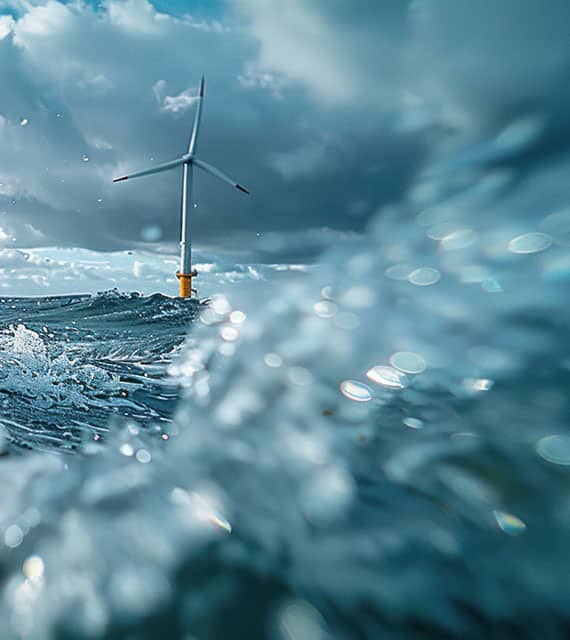
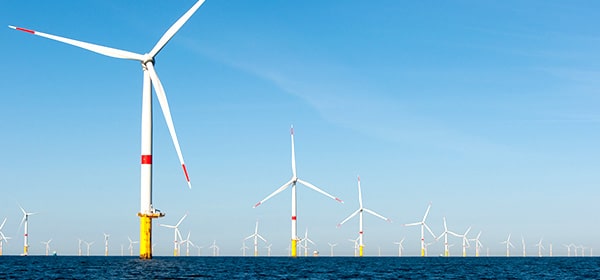
Breaking waves may induce extreme loads on bottom-fixed and floating offshore wind turbines. Despites the different Joint industry Projects already ran, many questions remain to be solved, to reduce the uncertainties associated with slamming loads in the design of turbines.
• Irregular waves and slamming loads in intermediate water with flat bottom
• Regular and irregular waves in shallow water with bottom slope: characteristics of shoaling and breaking waves, extension of the DIMPACT method to a wider range of wave conditions, dynamic and hydroelastic effects
• Structural response of a cylinder undergoing slamming loads
• Potential flow modeling of irregular nonlinear waves in intermediate to shallow water to treat breaking occurrence and dissipation
• Slamming and non-slamming loads distinction within a given wave, and structure response to slamming loads using CFD simulations
• Characterization of extreme and breaking waves in the field: data collection and analysis from La Jument lighthouse and Fécamp met mast
• Joint measurements of breaking waves, slamming loads and structure response of Fécamp met mast
• Definition of slamming and non linear wave loads from linear waves properties
• Non linear load models improvement: incorporation of the effect of the spatial offset between the wave breaking maximum and the structure’s position
• Validation of DIMPACT’s design sea state approach and explicitly relate it to a return period
• Implementation of linear slamming definition method in offshore wind turbines coupled models (specially OpenFAST and DIEGO) and inclusion of the effect of distance to breaking, load phasing and space-time evolution of the breaking waves
• Benchmark of slamming formula in coupled offshore wind turbines models
• Numerical investigation of the effect of breaking waves on global floating offshore wind turbines response with comparison with wave tank experiments
• Incorporation of DIMPACT+ new methods into the industrial project partners engineering tools
• Recommendations for certification standards
Lorem ipsum dolor sit amet consectetur.
Sagittis maecenas aliquam integer lobortis eu dignissim blandit tellus metus. Amet et tristique malesuada mattis pharetra bibendum purus id. Risus in elit ullamcorper ut. Imperdiet amet id feugiat arcu malesuada at ut vulputate condimentum.
This project is led by France Energies Marines.
This project receives French State funding managed by the National Research Agency under the France 2030 investment plan (ANR-10-IEED-0006-34). It also receives financial support from Normandy region and European Union, Pôle Mer Bretagne Atlantique, Brittany region, and Université Gustave Eiffel.
This project is certified by the maritime cluster Pôle Mer Bretagne Atlantique.
Lorem ipsum dolor sit amet, consectetur adipiscing ut elit tellus
We use cookies to personalize content, provide social media features, and analyze our traffic. We also share information about your use of our site with our analytics partners. You can change your preferences at any time. For more information, please see our Privacy Policy and Cookie Policy.