Investigating interactions between fish and offshore wind farms
Duration: 36 months (2024 - 2027)
Budget: €4,053K
Motivation & background
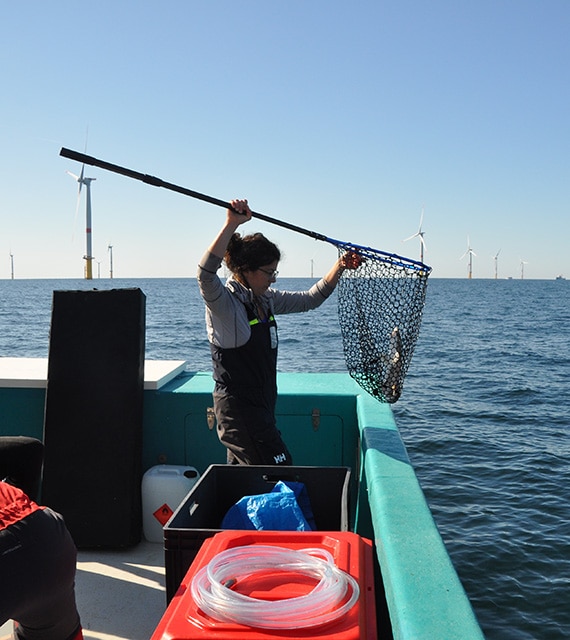
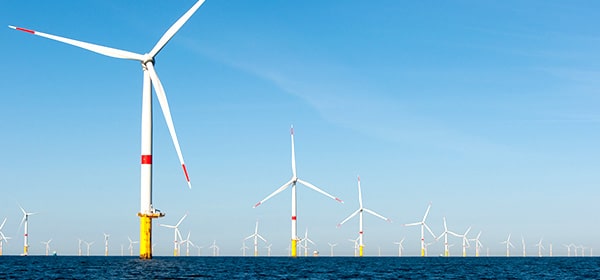
Considering the ecological functions and socio-economic importance of fish, species responses to offshore wind farms (OWF) need to be assessed through comprehensive and long-term monitoring. The FISHOWF R&D project, completed in 2023, demonstrated the relevance of acoustic telemetry for monitoring the effects of offshore wind farms on fish. Building on this, the FISHOWF+ project will implement this technology in 6 offshore wind farms (both fixed and floating) across 3 French maritime regions to address several key questions related to fish presence and behaviour within and across wind farm development areas.
Objectives
Characterise the interactions between fish and offshore wind farms and their export cables at multiple spatial scales through an in situ monitoring approach based on acoustic telemetry
Promote and facilitate the integration of acoustic telemetry into national marine environment monitoring strategies
Integrate France’s monitoring efforts and results into European collaborations to assess the effects of offshore wind farm development on fish movements in the North-East Atlantic
Work planned
1. Stakeholder engagement and transferability
• Promoting telemetry tools for risk mitigation
• Knowledge sharing and perspectives
• Advocating for acoustic telemetry integration
2. Understanding impacts at different stages of OWF lifecycle
• Tagging species of interest accross different French Facades
• Deploying acoustic arrays within OWF areas
• General analysis and biological interpretation on impacts of OWF on space use and occupancy patterns of fish
3. Free-swimming fish behaviour near EMF-emitting subsystems
• Tagging electrosensitive species .
• Deploying dedicated multilateral acoustic telemetry arrays and data collection
• Detecting fine-scale 3D movements of electrosensitive species around two EMF-emitting OWF structures
4. Role of OWF on regional dynamics of fish ecology
• Inferring fish movements using geolocation models
• Building a trajectory simulation tool to infer population level-fish space use and movements: a sea bass case study
• Assessing the connectivity between OWF sites
• Transfer of new ecological data to ecosystem-based modelling
Sagittis maecenas aliquam integer lobortis eu dignissim blandit tellus metus. Amet et tristique malesuada mattis pharetra bibendum purus id. Risus in elit ullamcorper ut. Imperdiet amet id feugiat arcu malesuada at ut vulputate condimentum.
Partners
This project is led by France Energies Marines
Funding
This project receives French State funding managed by the French National Research Agency under the France 2030 investment plan. It is also supported by the Pays de la Loire, SUD Provence-Alpes-Côte d’Azur, Brittany and Normandy regions.
Accreditation
This project is certified by the maritime cluster Pôle Mer Bretagne Atlantique.
Pour aller plus loin
Ajoutez votre titre ici
Lorem ipsum dolor sit amet, consectetur adipiscing ut elit tellus
We use cookies to personalize content, provide social media features, and analyze our traffic. We also share information about your use of our site with our analytics partners. You can change your preferences at any time. For more information, please see our Privacy Policy and Cookie Policy.