Test and monitoring means
Fecamp offshore met mast
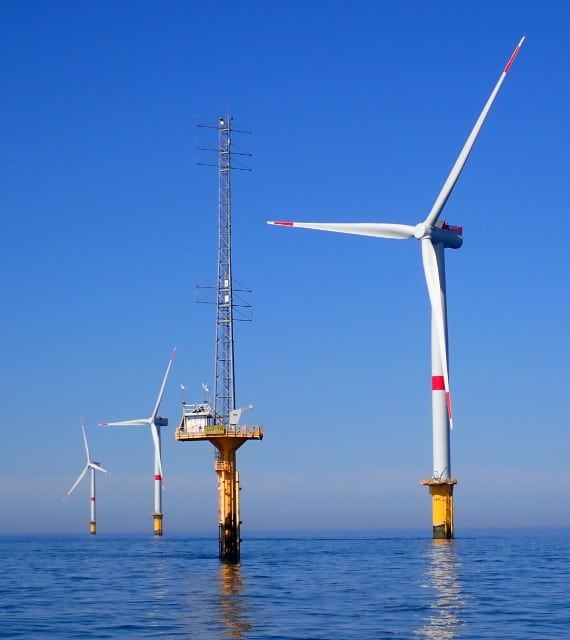
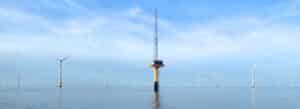
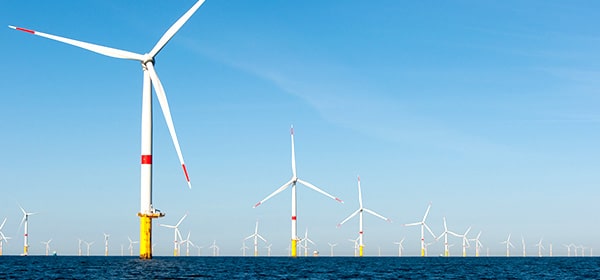
Since 2023, we have been operating the Fecamp met mast, France’s first research platform dedicated to offshore wind energy. This facility is located at the southern edge of the Fecamp wind farm, 13 km off shore.
State-of-the-art equipment available on the Fecamp mast
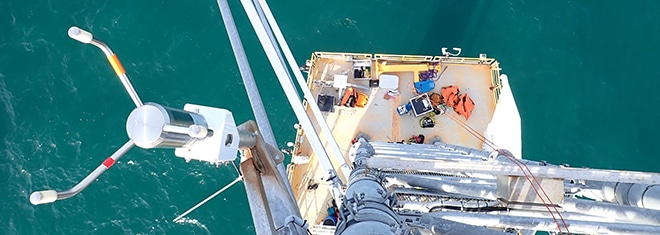
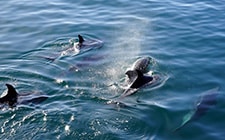
The Fecamp mast stands on a gravity foundation and rises 60 metres above sea level. It is an ideal site for testing and validating innovative solutions. The aerial section of the mast is currently fitted with acoustic recorders, 4K/360° cameras, camera traps and a Motus station. These instruments enable the detection and observation of birds and bats. Underwater, F-PODs, hydrophones and acoustic receivers track marine mammals, fish and crustaceans. The instrumentation also includes devices for measuring atmospheric turbulence: a sonic anemometer, a profiling lidar and meteorological probes. It also includes sensors monitoring the structural behaviour of the mast: pressure sensors, accelerometers and a stereo video system.
Why work with us?
Get access to a unique range of services
Gain access to the mast and benefit from our support
We offer a unique service package designed to support those behind innovative projects. This package enables you to demonstrate capabilities and validate solutions in an offshore environment. It includes access to the mast and support from our experts for the testing, development and validation of demonstrators under real-world conditions. We offer simplified access protocols and a wide range of services: consultancy, deployment, maintenance, data collection and analysis.
Access to rare data
Since 2023, we have been collecting unique data using the instrumentation deployed on the Fecamp mast as part of the DRACCAR programme. This enables us to gather rare data on the species present at sea, their populations, and how they interact with an offshore wind farm. We have indicators covering all components of the ecosystem: benthos, fish, birds and marine mammals. Data from various biological components make it possible to characterise the phenomenon of biocolonisation in this area. At the same time, several environmental parameters, such as temperature, pressure, air humidity and atmospheric turbulence, are measured in situ and continuously. Lastly, comprehensive measurements describe the meteorological and oceanographic conditions that can influence the platform’s structure and its response to breaking waves. Some of this data can be made available as services to industrial, institutional or academic stakeholders. Taken together, these features make the mast a unique observatory in Europe.

Conducting cutting-edge R&D
Since 2023, we have been leading the DRACCAR programme alongside 30 partners, deploying state-of-the-art instruments, collecting unprecedented data and developing innovative monitoring methods. Structured around six complementary R&D thematic areas, this programme ensures a robust and multidisciplinary scientific approach. These cover the study of marine ecosystems (megafauna, benthic organisms and other species), as well as the analysis of wind, hydro-sedimentary processes and the behaviour of wind turbine structures exposed to the elements.
A true catalyst for innovation, the Fecamp mast enhances our ability to support industry and the government. It facilitates high-level field studies and strengthens collaboration with research stakeholders.
Operational and scientific teams working on the front line every day
Instrumentation & Data Acquisition
This team specialises in the deployment of biological and physical sensors, as well as in the collection of hydrographic and oceanographic data. It oversees field campaigns, from preparation through to post-campaign follow-up. It manages large datasets, as well as the deployment, operation and maintenance of instruments on the mast.
Wildlife & Interactions
This team studies the impacts of environmental changes caused by offshore wind farms and human activities on the environment across the various components of the ecosystem. It develops and applies innovative methods, including acoustic telemetry, environmental DNA, algorithm development and machine learning. Data is collected from the mast and other means to analyse the effects on the ecosystem.
Find out where our test and monitoring means are located
Thanks to our unique at-sea test and monitoring facilities, long-term observations and experiments can be carried out in offshore environments. It is crucial for stakeholders in the sector to have access to data acquired in the field, under real-life conditions.
Our references
The evaluation process is not simply a box-checking exercise, it’s a real opportunity to discuss the content.
Another key strength of this Committee was that it is made up of researchers from different backgrounds, laboratories and countries. This leads to very rich and stimulating discussions.
We often tend to work on individual projects. The DRACCAR-MMERMAID research project gives us the opportunity to be involved in studying cumulative effects at the scale of an entire coastline.