Research & Development

Projet

DIMPACT+

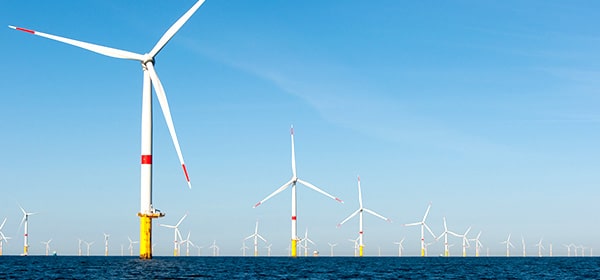
Design of offshore wind turbines and impact of extreme and breaking waves

Motivation & background

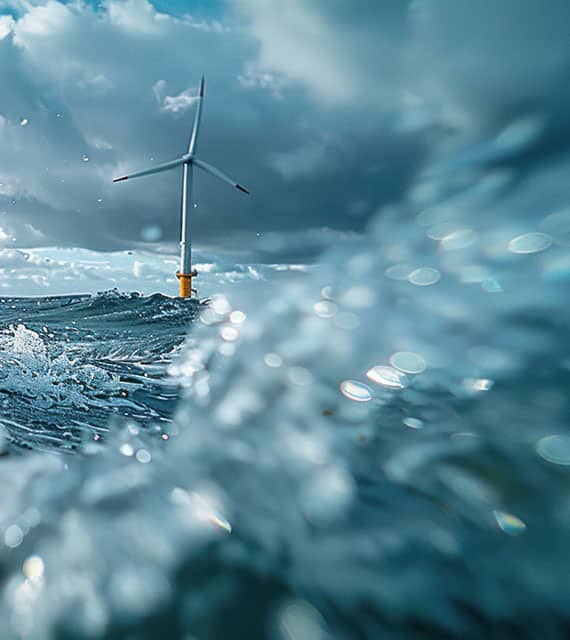
Breaking waves may induce extreme loads on bottom-fixed and floating offshore wind turbines. Despites the different Joint industry Projects already ran, many questions remain to be solved, to reduce the uncertainties associated with slamming loads in the design of turbines.

  • Is the standard definition of the design sea state and wave valid in presence of breaking waves, since the most severe slamming loads are not necessarily associated with the highest waves?
  • What are the statistics, shape and kinematic properties of breaking waves in severe sea states?
  • Can we infer the slamming loads on an offshore structure, knowing only the undisturbed wave properties?
  • Can we derive simplified approaches to capture slamming loads directly in the fully coupled offshore wind turbines numerical models used in the design process?
  • What is the effect of floater motions and tilt angles on slamming loads?
Projet DIMPACT+

Objectives

  • To consolidate the DIMPACT design sea state definition and improved slamming methods implemented in OWT coupled models and in DNV practices
  • To test the DIMPACT method in shallow water with a constant bottom slope and develop numerical codes able to simulate non linear waves that will be used as input of offshore wind turbines coupled models

Scientific work planned

Flume experiments

• Irregular waves and slamming loads in intermediate water with flat bottom
• Regular and irregular waves in shallow water with bottom slope: characteristics of shoaling and breaking waves, extension of the DIMPACT method to a wider range of wave conditions, dynamic and hydroelastic effects
• Structural response of a cylinder undergoing slamming loads


Numerical modeling

• Potential flow modeling of irregular nonlinear waves in intermediate to shallow water to treat breaking occurrence and dissipation
• Slamming and non-slamming loads distinction within a given wave, and structure response to slamming loads using CFD simulations

Field experiments

• Characterization of extreme and breaking waves in the field: data collection and analysis from La Jument lighthouse and Fécamp met mast
• Joint measurements of breaking waves, slamming loads and structure response of Fécamp met mast

Engineering approaches

• Definition of slamming and non linear wave loads from linear waves properties
• Non linear load models improvement: incorporation of the effect of the spatial offset between the wave breaking maximum and the structure’s position
• Validation of DIMPACT’s design sea state approach and explicitly relate it to a return period

Transfer to industry – Coupled models and recommendations for offshore wind

• Implementation of linear slamming definition method in offshore wind turbines coupled models (specially OpenFAST and DIEGO) and inclusion of the effect of distance to breaking, load phasing and space-time evolution of the breaking waves
• Benchmark of slamming formula in coupled offshore wind turbines models
• Numerical investigation of the effect of breaking waves on global floating offshore wind turbines response with comparison with wave tank experiments
• Incorporation of DIMPACT+ new methods into the industrial project partners engineering tools
• Recommendations for certification standards

Expected deliverables

  • Recommendations for certification documents that define the design sea states in the presence of breaking waves and for the engineering methods assessing extreme and breaking wave loads
  • Offshore wind turbines coupled models OpenFAST and DIEGO) improved with more efficient methods for quantifying the extreme and breaking wave loads
  • Incorporation of DIMPACT+ new methods into the industrial project partners engineering tools

Conclusion

Lorem ipsum dolor sit amet consectetur.

Sagittis maecenas aliquam integer lobortis eu dignissim blandit tellus metus. Amet et tristique malesuada mattis pharetra bibendum purus id. Risus in elit ullamcorper ut. Imperdiet amet id feugiat arcu malesuada at ut vulputate condimentum.

Partners

This project is led by France Energies Marines.

Logo France Energies Marines
Logo Bureau Veritas 2025
Logo Ecole Nationale des Ponts et Chaussées
Logo EDF
Logo ENSTA
Logo Equinor
Logo Iberdrola
Logo Ifremer
Logo Saipem
Logo Skyborn
Logo Supergen ORE
Logo Université Le Havre Normandie
Logo University of Plymouth

Funding

This project receives French State funding managed by the National Research Agency under the France 2030 investment plan (ANR-10-IEED-0006-34). It also receives financial support from Normandy region and European Union, Pôle Mer Bretagne Atlantique, Brittany region, and Université Gustave Eiffel.

Logo France 2030
Logo Région Normandie
Logo FEDER
Logo Pôle Mer Bretagne Atlantique
Logo Région Bretagne
Logo Université Gustave Eiffel

Accreditation

This project is certified by the maritime cluster Pôle Mer Bretagne Atlantique.

Logo Pôle Mer Bretagne Atlantique

Pour aller plus loin

Ajoutez votre titre ici

Lorem ipsum dolor sit amet, consectetur adipiscing ut elit tellus

Ajoutez votre titre ici

Lorem ipsum dolor sit amet, consectetur adipiscing ut elit tellus

Ajoutez votre titre ici

Lorem ipsum dolor sit amet, consectetur adipiscing ut elit tellus

Know more

Would you like to know more ?