Acoustic telemetry for tracking fish and crustaceans
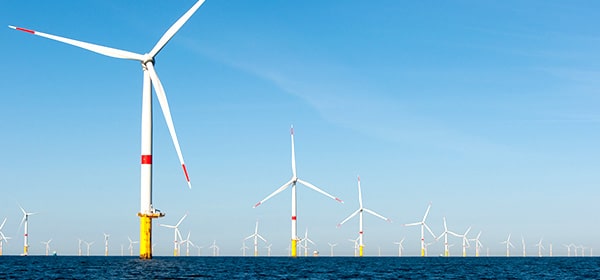
We run acoustic telemetry networks dedicated to monitoring fish and crustaceans in seven French offshore wind farms. This unique infrastructure enables us to monitor the presence and behaviour of marine mobile species specifically in these developing areas, but also on a wider scale.
An acoustic telemetry network covering seven offshore wind farms
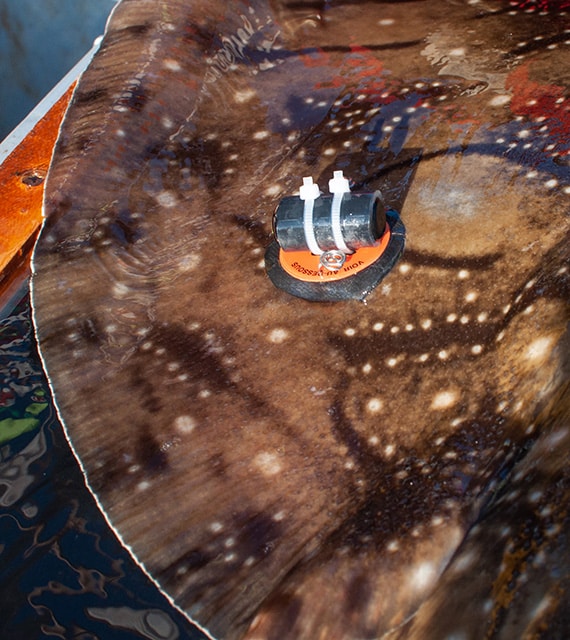
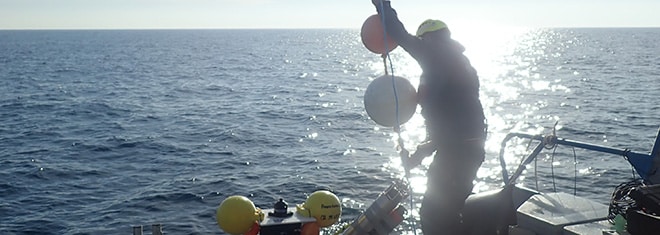
We have deployed and operate more than 80 acoustic telemetry receivers across seven French offshore wind farms, either in operation or under construction, located in the English Channel, the Atlantic and the Mediterranean. These specialised hydrophones detect the acoustic signals emitted by individual tags fitted to various species of fish and crustaceans. This enables us to reconstruct the trajectories of tracked animals, thereby gaining a better understanding of their presence and behaviour within and between offshore wind farm development areas. More than 300 individuals, mainly rays and sharks, sea bass, sea bream and lobsters, have been tagged to date. Our network is also compatible with the equipment used in numerous other European initiatives, thereby helping to advance scientific knowledge across Europe.
Why work with us?
Benefit from a unique range of services
Deploying receivers in wind farms to obtain high-quality data is not something that can be done on the spur of the moment. We have many years of experience in deploying and maintaining acoustic telemetry networks. Since 2022, we have been monitoring several hundred individuals from 19 different species roaming freely in the wild. To date, over 2 million detections have been recorded, forming a rare database. From the installation of acoustic telemetry receivers to data processing and analysis, we can guide you with proven protocols and methodology. We also maintain an international network of experts in this technology.
Since 2021, we have been using acoustic telemetry to develop a long-term monitoring approach to assess the effects of offshore wind farms – both fixed and floating – on fish and crustaceans. Having demonstrated the relevance of this technology, we are now using it to characterise the interactions between fish and offshore wind farms, as well as their export cables, at different spatial scales. For example, we have developed a reproducible method to study, in their natural environment, the behaviour of free-roaming fish around systems emitting electromagnetic fields. In parallel, we are participating in European collaborations to assess the effects of offshore wind farm development on fish movements across the North-East Atlantic. This work contributes to a better understanding of the ecological impacts of offshore renewable energy.
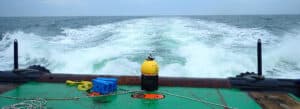
This team specialises in the deployment of equipment and the acquisition of offshore data. It specifies measurement systems suited to the study sites and oversees operations at sea in accordance with best practices in occupational safety. It has a track record of numerous missions involving the deployment and maintenance of acoustic telemetry receivers. It also assists the scientific team with the tagging of tracked animals.
Wildlife & Interactions
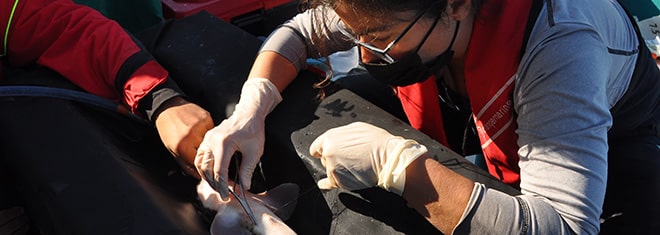
In this R&D department, several marine biologists possess expertise in mobile marine fauna. Capable of conducting animal surgery in accordance with strict ethical guidelines, they define equipment deployment protocols, lead and participate in fieldwork, and analyse and interpret acoustic telemetry data. They are also proficient in all the administrative procedures required to obtain the necessary legal authorisations, ensuring that every operation carried out in the field complies with regulations
Find out where our test and monitoring means are located
Thanks to our unique at-sea test and monitoring facilities, long-term observations and experiments can be carried out in offshore environments. It is crucial for stakeholders in the sector to have access to data acquired in the field, under real-life conditions.
Our references
The evaluation process is not simply a box-checking exercise, it’s a real opportunity to discuss the content.
Another key strength of this Committee was that it is made up of researchers from different backgrounds, laboratories and countries. This leads to very rich and stimulating discussions.
We often tend to work on individual projects. The DRACCAR-MMERMAID research project gives us the opportunity to be involved in studying cumulative effects at the scale of an entire coastline.
We use cookies to personalize content, provide social media features, and analyze our traffic. We also share information about your use of our site with our analytics partners. You can change your preferences at any time. For more information, please see our Privacy Policy and Cookie Policy.