Towards a multi-model approach of indicators of ecosystem services
Duration: 24 months (2020-2022)
Budget: €1,076K
Background & motivation
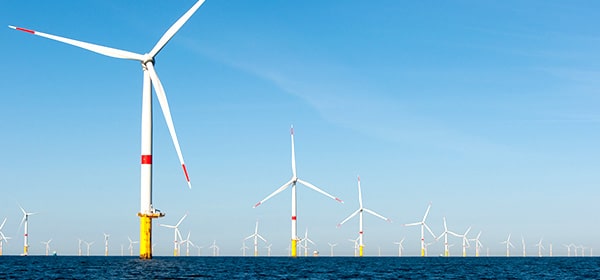
Marine ecosystems provide ecosystem services to human populations but under increasing anthropogenic pressure their production is disrupted. In addition, the development of offshore wind farms is required and is leading to the idea of a “win-win” strategy by reconciling clean energy production and preservation of biodiversity and the resulting ecosystem services. But for that, it is essential to understand and predict impacts, both positive or negative, of offshore wind farms on the ecosystems and to assess current ecosystem services and their evolution.
Objectives
To develop a multi-model approach to predict offshore wind farm impacts on ecosystems and the resulting services.
To guide a win-win strategy between offshore wind farm developments and conservation strategies.
Main achievements
Development of an innovative End-to-End model consisting of a spatialized trophic model (Ecospace) forced by outputs of ecological niche models and by outputs of a biogeochemical model (ERSEM)
Proposal of new spatializable ecosystem service indicators in relation to offshore wind energy
Resources generated
Models for representing the trophic functioning of ecosystems in the Eastern Channel and Southern North Sea as well as the Gulf of Lion in the Mediterranean
An integrated conceptual model to characterise the effects of offshore Wind farms on ecosystem services: case study of the Dunkirk offshore wind farm
Recommendations for the transfer of the integrated conceptual model developed in the Dunkirk area to other ORE farm development areas
WINDSERV has enabled the development of the first ever conceptual model approach to characterise the link between ORE development and ecosystem services. This will provide a basis for understanding the conflicts and synergies between offshore wind development and socio-ecosystem considerations. WINDSERV’s End-to-End model will provide robust future predictions and projections of the functioning of the ecosystems into which ORE farms are integrated through the coupling of ecological and biogeochemical approaches. WINDSERV’s innovative approaches will be key tools for the study of cumulative impacts at sea in the NESTORE project.
Partners
This project was led by Université de Littoral Côte d’Opale et France Energies Marines.
Funding
This project received French State funding managed by the National Research Agency under the Investments for the Future Programme (ANR-10-IEED-06-34).
Accreditation
This project was certified by the maritime clusters Pôle Mer Bretagne Atlantique and Pôle Mer Méditerranée.
Pour aller plus loin
Ajoutez votre titre ici
Lorem ipsum dolor sit amet, consectetur adipiscing ut elit tellus
We use cookies to personalize content, provide social media features, and analyze our traffic. We also share information about your use of our site with our analytics partners. You can change your preferences at any time. For more information, please see our Privacy Policy and Cookie Policy.