Research & Development
Projet
STORM
Strategies and tool for offshore reliability and maintenance
- Duration: 24 months (2024-2026)
- Budget: €1,360K
Motivation & background
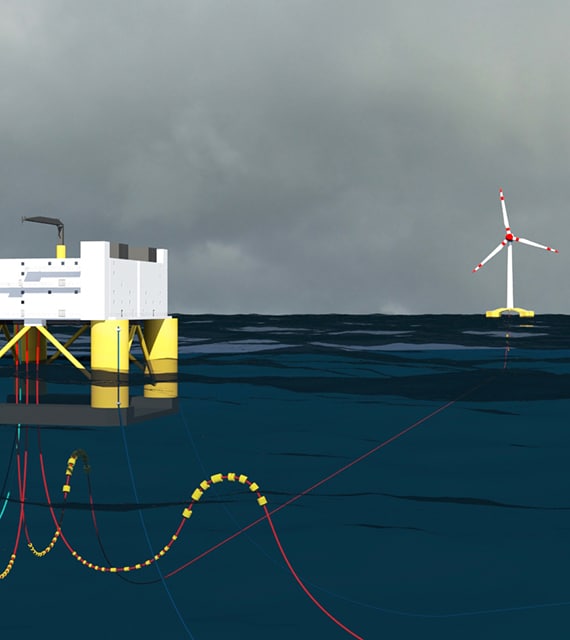
Floating wind farms present unique challenges in terms of maintenance and monitoring. During a previous project called MOSISS, a comprehensive methodology was initiated for electrical and mechanical in-service monitoring of floating offshore electrical substations. This methodology is based on mean time to failure (MTTF) assessment.
The offshore context means that access to equipment at sea varies considerably. The MTTF therefore needs to be refined to take into account other indicators such as the mean time to receive an alert, supply, access to the site, repair and the mean time to the next failure. This is the aim of the JIP STORM, which will provide answers to a number of questions.
- What is the impact of the mean time to access on calculating the reliability of a complex offshore system?
- How do the accessibility and maintainability of a farm affect its reliability and production?
- What strategies for managing spare parts, the fleet and the reliability of sub-components can maximise the farm uptime while minimising maintenance costs?
Objective
- To develop an integrated tool for quantifying and optimising the availability and maintenance costs of floating offshore wind farms in relation to a given architecture and geographical location
Scientific content
Methodologies development to assess reliability, availability and spare strategy
• Advanced reliability methodology and mean downtime computation
• Definition of marine fleet management strategies and impact on the maintenance operation duration
• Data collection to assess the quality of monitoring and inspection
• Sensitivity analysis of farm reliability
• Specification and structuration of the reliability calculation tool
Definition of the operability depending on the operation and vessel type
• Case study specifications
• Definition of meteocean limitations for site access, taking into account the type of vessel
• Assessment and quantication of the probability of specific operations being carried out
• Mean time to access computation

Cases study and optimisation
• Definition of key rerformance indicator for optimisation
• Development of a method for operation and maintenance strategies optimisation
• Case study analysis
Expected outputs
- Methodology for the calculation of floating wind farms reliability depending on inspection strategy
- Method for considering strategic choices in components redundancy, spare parts stock and marine fleet management
- A tool for optimising the key performance indicators of the overall strategy at the floating offshore wind farm scale
Conclusion
Lorem ipsum dolor sit amet consectetur.
Sagittis maecenas aliquam integer lobortis eu dignissim blandit tellus metus. Amet et tristique malesuada mattis pharetra bibendum purus id. Risus in elit ullamcorper ut. Imperdiet amet id feugiat arcu malesuada at ut vulputate condimentum.
Partners
This project is led by France Energies Marines.
Funding
This project receives French State funding managed by the National Research Agency under the France 2030 investment plan (ANR-10-IEED-0006-34).
Accreditation
This project is certified by the maritime cluster Pôle Mer Bretagne Atlantique.
Pour aller plus loin
Ajoutez votre titre ici
Lorem ipsum dolor sit amet, consectetur adipiscing ut elit tellus
Ajoutez votre titre ici
Lorem ipsum dolor sit amet, consectetur adipiscing ut elit tellus
Ajoutez votre titre ici
Lorem ipsum dolor sit amet, consectetur adipiscing ut elit tellus