Research & Development

Project

DIMPACT

Design of floating wind turbines and impacts of energetic steep and breaking waves

Context

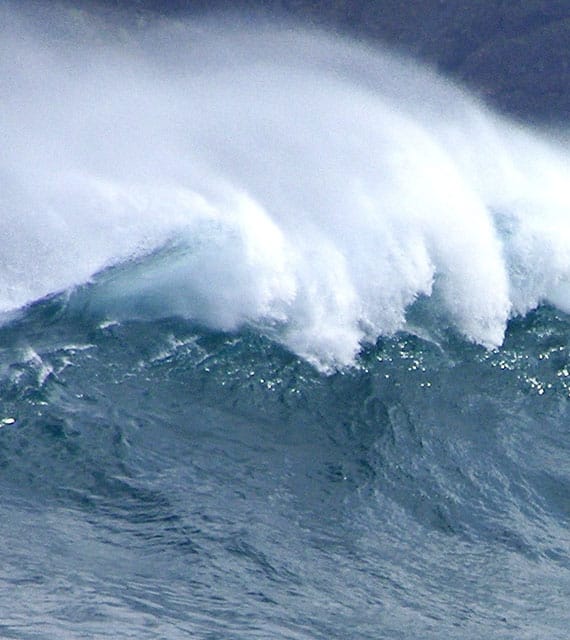
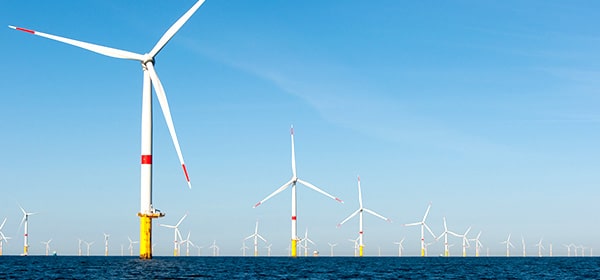
Floating offshore wind turbines will generally be deployed in areas with strong winds and powerful waves. This needs to be taken into account at the design stage because of the damage that can be caused to systems.


To date, little account has been taken of the loads caused by the extreme waves that apply to floating wind turbines. We therefore need to go further in defining specific engineering methods to take into account the effect of breaking waves on floating wind turbines.


Projet DIMPACT

Objective

  • To develop new tools to improve the design of floating offshore wind turbines by better integrating loads due to wave breaking

Main achievements

Study of the geometric and kinematic properties of breaking waves using numerical simulations and tank experiments

Wave channel tests using an instrumented cylinder representative of a spar turbine to reproduce the movements and inclinations typical of a floating wind turbine

Establishment of a relationship between the properties of breaking waves and the loads exerted on the cylinder in order to assess the loads induced by breaking waves in any sea state

Development and validation of an engineering formula specific to floating wind turbines, taking into account the movement and inclination of the turbine subjected to loads induced by extreme waves

Development of a solution for estimating the loads induced by equivalent non-linear waves, based on the properties of linear waves

Development of an engineering method to take account of the slamming force on the floating wind turbine, then integration into the codes of the DIEGO and OpenFAST tools

Main outputs

  • New method for defining the design sea state in coupled aerohydrodynamic models of floating wind turbines
  • New engineering solution for estimating non-linear wave-induced loads in coupled numerical models, mentioned in version 2024 of the guidance documents published by the DNV certification body

Conclusion

DIMPACT has led to the development of a method for defining the design sea state specific to floating offshore wind turbines. An engineering solution has also been developed for estimating the loads caused by non-linear waves in coupled numerical models such as OpenFAST. This is mentioned in the recommendation documents published in 2024 by the DNV certification body
Partners

This project was led by France Energies Marines.

Logo France Energies Marines
Logo Cerema
Logo DNV-GL
Logo Ecole Nationale des Ponts et Chaussées
Logo EDF
Logo ENSTA Bretagne
Logo Ifremer
Logo CNR ISMAR
Logo Morphosense
Logo Ocean Innovation Nowegian Catapult Centre
Logo RWE
Logo Saipem
Logo Shell
Logo SHOM
Logo TotalEnergies
Logo Unitech
Logo University of Rhode Island

Funding

This project received French State funding managed by the National Research Agency under the France 2030 investment plan (ANR-10-IEED-0006-34). It also received financial support from the Brittany and La Réunion regions.

Logo France 2030
Logo Région Bretagne
Logo Région Réunion

Accreditation

This project was certified by the maritime clusters Pôle Mer Bretagne Atlantique and Pôle Mer Méditerranée.

Logo Pôle Mer Bretagne Atlantique
Logo Pôle Mer Méditerranée

Pour aller plus loin

Ajoutez votre titre ici

Lorem ipsum dolor sit amet, consectetur adipiscing ut elit tellus

Ajoutez votre titre ici

Lorem ipsum dolor sit amet, consectetur adipiscing ut elit tellus

Ajoutez votre titre ici

Lorem ipsum dolor sit amet, consectetur adipiscing ut elit tellus

Know more

Would you like to know more ?

This website uses cookies

We use cookies to personalize content, provide social media features, and analyze our traffic. We also share information about your use of our site with our analytics partners. You can change your preferences at any time. For more information, please see our Privacy Policy and Cookie Policy.