Research & Development
Projet
AFOSS-DC
Architecture and design of floating offshore substation for direct current applications
- Duration: 36 months (2022-2025)
- Budget: €1,600K
Context
The increasing distance of future offshore wind farms from the coast, combined with the energy losses inherent in this type of installation, make high-voltage direct current (HVDC) a competitive alternative. The design of floating electrical substations operating with this technology raises a number of issues that require R&D work.
It is necessary to define the electrical components for HVDC applications in terms of weight, volume and sensitivity to the movement of the floater, whilst estimating the typical movements and vibrations of the structure. It is crucial to correctly design the HVDC dynamic cable and its connection system.

Objective
- To study the HVDC floating offshore substation as an integrated system through analyses of functional requirements, integration constraints, risk and reliability
Main achievements
Design of electrical systems and topside layout
Design of a semi-submersible platform and a tension-leg platform (or TLP) and motion analysis
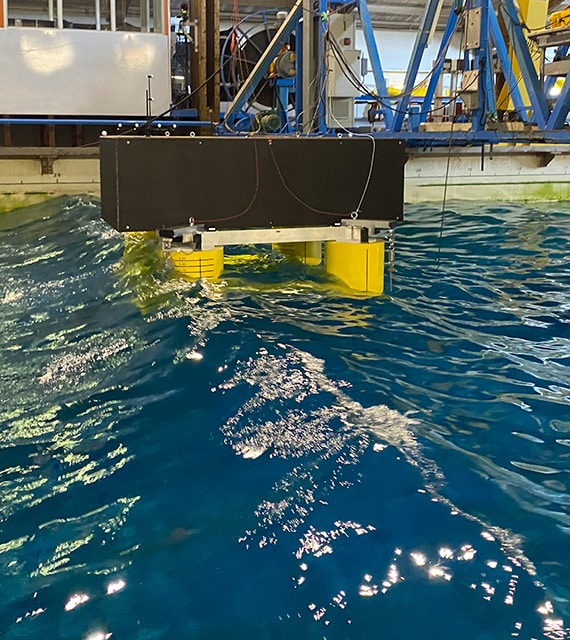
Hydrodynamic tank tests using a 1:50 scale model of the TLP
Thermal and electrical design of the cross-sectional area of dynamic electrical cables and determination of their configuration
Analysis of the system’s reliability, CAPEX and OPEX
Roadmap for the qualification strategy for such a system
Resources generated
- Design: topside with electrical architecture, semi-submersible platform, TLP platform, dynamic cable cross-section, dynamic cable configuration
- Databases: hydrodynamic basin tests on a TLP model, monitoring the structure’s motion, wave-induced forces, relative wave height and tension in the moorings
- Cost-related analyses: reliability, CAPEX, OPEX
- Recommendations: validation and qualification strategy for a floating offshore HVDC substation
Conclusion
AFOSS-DC has enabled the identification of the main failure modes of a floating HVDC substation and the assessment of its reliability. The different critical components (electrical architecture, semi-submersible and TLP floaters, moorings and dynamic cables) have been designed, incorporating a motion analysis. Wave basin tests were conducted to study this aspect in practice on the TLP platform. On this solid basis, a CAPEX and OPEX assessment was carried out and a roadmap for qualifying such a system was drawn up.
Partners
This project was led by France Energies Marines.
Funding
This project received French State funding managed by the National Research Agency under the France 2030 investment plan (ANR-10-IEED-0006-34). It also received financial support from the Occitanie, Pays de La Loire and SUD Provence-Alpes-Côte d’Azur regions.
Labellisation
Lorem ipsum dolor sit amet consectetur. Sagittis maecenas aliquam integer lobortis eu dignissim blandit tellus metus. Amet et tristique malesuada mattis pharetra bibendum purus id. Risus in elit ullamcorper ut. Imperdiet amet id feugiat arcu malesuada at ut vulputate condimentum.
Pour aller plus loin
Ajoutez votre titre ici
Lorem ipsum dolor sit amet, consectetur adipiscing ut elit tellus
Ajoutez votre titre ici
Lorem ipsum dolor sit amet, consectetur adipiscing ut elit tellus
Ajoutez votre titre ici
Lorem ipsum dolor sit amet, consectetur adipiscing ut elit tellus