Research & Development

Projet

DRACCAR-NEMO

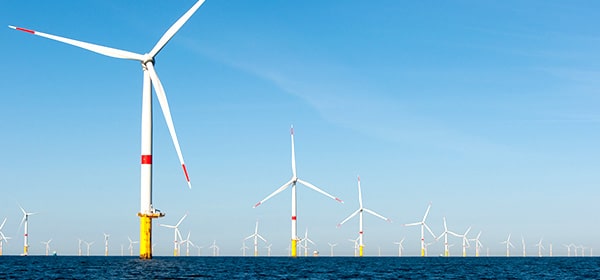
New methods for turbulence measurements and models in offshore wind

Context

A key phase in the development of a wind energy project is a comprehensive assessment of the inflow wind conditions. This is essential to determine the financial feasibility of a project.

Whilst the characteristics of the mean flow (like speed, direction) are relatively simple to assess by modelling or measurement tools, a lack of confidence in the characterization of wind fluctuations, i.e., turbulence, over a range of scales, has subsequently resulted in high levels of conservativeness being employed by wind turbine designers.

DRACCAR-NEMO Project

Objective

  • To provide methodologies and tools for a comprehensive assessment of turbulence at prospective offshore wind sites

Scientific work planned

Review and redefinition of turbulence metrics for the offshore wind applications

Measurements of atmospheric turbulence

• Improvement of reconstruction procedures of turbulence metrics derived from lidar profiler
• Derivation of turbulence from scanning lidars in dual-Doppler configuration
• Investigation and implementation of universal multifractals for higher-order turbulence statistics

• Joint measurement campaign at Normandy test site to support method development

Modeling of turbulent flows

• Calibration of turbulence length-scales (100m – 1,000 m) using large eddy simulations and incorporate them into mesoscale model
• Adaptation of numerical model settings to derive recommendations for turbulence data simulation
• Assessment of different lidar configurations’ ability to reconstruct turbulence information through virtual lidars in large eddy simulationwind fields

Reconstruction of offshore wind metrics using data-driven methods

• Use of statistical and machine learning models to estimate offshore wind metrics from onshore measurements and numerical models outputs
• Comparison of data-driven models and large eddy simulations for offshore turbulence forecasting

Expected results

  • Collection of a new turbulence dataset
  • Methodology for the reconstruction of turbulence from wind lidars (ground-based, floating and scanning)
  • Industry applicable turbulence from meso-scale modelling
  • Site-specific transfer functions, combining observations and model output, to derive offshore information from onshore information

Conclusion

Lorem ipsum dolor sit amet consectetur.

Sagittis maecenas aliquam integer lobortis eu dignissim blandit tellus metus. Amet et tristique malesuada mattis pharetra bibendum purus id. Risus in elit ullamcorper ut. Imperdiet amet id feugiat arcu malesuada at ut vulputate condimentum.

Partners

This project is led by France Energies Marines.

Logo France Energies Marines
Logo Fraunhofer IWES
Logo Centrale Méditerranée
Logo CNRM
Logo Ecole Nationale des Ponts et Chaussées
Logo EDF
Logo Iberdrola
Logo Natural Power
Logo Pôle Mer Méditerranée
Logo RTE
Logo RWE
Logo Shell
Logo TotalEnergies

Funding

This project receives French State funding managed by the National Research Agency under the France 2030 investment plan (ANR-10-IEED-0006-34). It also receives financial support from Normandy region and European Union, Ifremer, Pôle Mer Méditerranée, and Occitanie and SUD Provence-Alpes-Côte d’Azur regions. 

Logo France 2030
Logo Région Normandie
Logo FEDER
Logo Ifremer
Logo Pôle Mer Méditerranée
Logo Région Occitanie
Logo Région SUD Provence-Alpes-Côte d'Azur

Accreditation

This project is certified by the maritime clusters Pôle Mer Bretagne Atlantique and Pôle Mer Méditerranée.

Logo Pôle Mer Bretagne Atlantique
Logo Pôle Mer Méditerranée

Pour aller plus loin

Ajoutez votre titre ici

Lorem ipsum dolor sit amet, consectetur adipiscing ut elit tellus

Ajoutez votre titre ici

Lorem ipsum dolor sit amet, consectetur adipiscing ut elit tellus

Ajoutez votre titre ici

Lorem ipsum dolor sit amet, consectetur adipiscing ut elit tellus

Know more

Would you like to know more ?