Research & Development
Project
TULIP
Turbulence with lidar profilers
- Duration: 36 months (2026-2029)
- Budget: €1,850K
Context
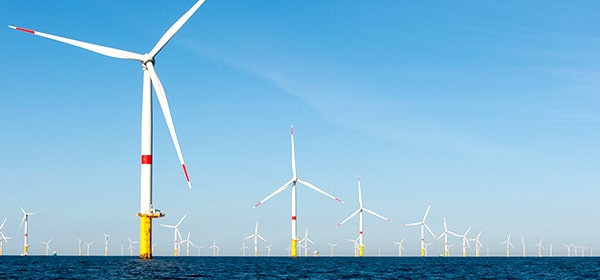
Lidar profilers are increasingly replacing meteorological masts for site assessment thanks to their lower deployment costs and ability to measure at turbine heights.
Because atmospheric turbulence plays a critical role in both loads assessment and annual energy production calculations, capturing it accurately is essential.
But retrieving turbulence from lidar measurements still falls short, leading to accuracy challenges that become even more pronounced for floating offshore deployments.
Objective
- To get advanced turbulence intensity measurement from fixed and floating wind lidar profilers towards industry-standard accuracy and bankable confidence levels
Scientific content
Method demonstration on fixed lidar profilers
• Extension of TwinDAR© to several pulsed lidar technologies and preliminary assessment for continuous-wave lidar
• Development of advanced methods for instrumental noise reduction and intra-beam effects mitigation
• Onshore measurement campaign and validation against DTU’s Østerild met mast up to 244 m
Method demonstration moving lidar profilers
• Refinement of the motion compensation methodology
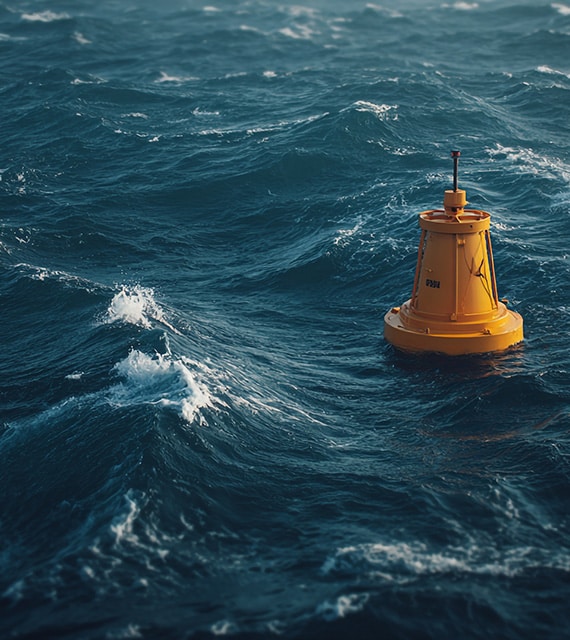
• Onshore measurement campaign with realistic buoy motions reproduced using a hexapod
• Validation jusqu’à 244 m par rapport au mât de mesure d’Østerild
• Validation up to 244 m against Østerild met mast
Improvement and validation of the TwinDAR© software
• Development of modular software components processing measurements from fixed and floating lidars
• Software validation up to TRL 5 thanks to onshore tests with the hexapod
• Progressive deployment of the software modules for partners
Technology transfer to industry and qualification
• Evaluation of the method according to the KPIs developed by DNV and industrial partners
• Preparation for the qualification of TwinDAR© by certification bodies
• Contribution to standards, including participation in IEA Wind Task 52

Expected results
- Mitigation techniques addressing instrumental noise and intra-beam averaging effects, compliant with France Energies Marines’ TwinDAR© methodology
- Motion-compensation methods for floating lidars in line with TwinDAR©’s approach
- Validated methods through acquisition of high-quality onshore datasets combining multi-lidar setups, controlled motions, and mast references
- New version of TwinDAR© software integrating newly developed methods, leading to accurate, unified, operational estimation of turbulence from fixed and floating pulsed lidars
Conclusion
Lorem ipsum dolor sit amet consectetur.
Sagittis maecenas aliquam integer lobortis eu dignissim blandit tellus metus. Amet et tristique malesuada mattis pharetra bibendum purus id. Risus in elit ullamcorper ut. Imperdiet amet id feugiat arcu malesuada at ut vulputate condimentum.
Partners
This project is leb by France Energies Marines.
Funding
This project receives French State funding managed by the National Research Agency under the France 2030 investment plan (ANR-26-IEED-0001). It also received financial support from Centrale Méditerranée, Pays de La Loire and SUD Provence-Alpes-Côte d’Azur regions.
Labellisation
Lorem ipsum dolor sit amet consectetur. Sagittis maecenas aliquam integer lobortis eu dignissim blandit tellus metus. Amet et tristique malesuada mattis pharetra bibendum purus id. Risus in elit ullamcorper ut. Imperdiet amet id feugiat arcu malesuada at ut vulputate condimentum.
Pour aller plus loin
Ajoutez votre titre ici
Lorem ipsum dolor sit amet, consectetur adipiscing ut elit tellus
Ajoutez votre titre ici
Lorem ipsum dolor sit amet, consectetur adipiscing ut elit tellus
Ajoutez votre titre ici
Lorem ipsum dolor sit amet, consectetur adipiscing ut elit tellus