Research & Development

Project

OMDYN2

Dynamic umbilicals for floating marine renewable energies technologies – Phase 2

Context

Dynamic power cables have been clearly identified as critical components for floating ORE systems. High voltage alternative current cables, known as HVAC, for floating wind turbines are the main concern at this stage. One of the challenges for the French industry is to identify the need to build, or adapt, a test bench that would account for the inherent coupling between the mechanical, electrical and thermal stresses involved.


Projet OMDYN2

Objective

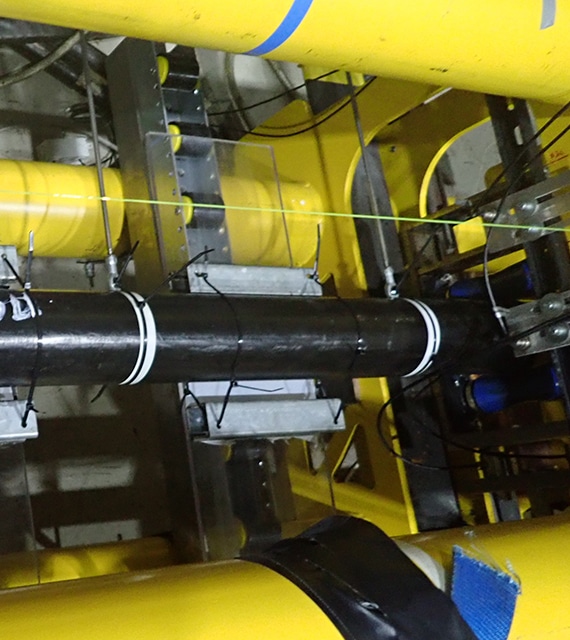
  • To experimentally characterise and then model the multiphysical stresses experienced by dynamic cables and propose a methodology for monitoring them in service

Main achievements

Characterisation of the mechanical behaviour of a dynamic cable as a function of temperature rise

Development of a local analytical cable section model and definition of global parameters for ensemble models

Implementation and calibration of a finite element volume model and inter-component friction model

Realisation of innovative tank tests at scale 1 of a cable colonized by mussels obtained by 3D printing

Proof of feasibility of curvature measurements using optical communication fibre, identification of conditions for measuring internal stresses by optical fibre

Main outputs

  • Database of bending stiffness of a dynamic cable as a function of temperature
  • 2D cross-section design software for fatigue calculation in copper armour and components
  • Automatic meshing module with graphical interface and definition of a 3D finite element dynamic cable model: translation of material properties, periodicity criteria, creation of boundary conditions
  • Unique database of hydrodynamic efforts representative of mussel colonisation
  • Laboratory tests identifying suitable optical measurement processes and measurable curvature ranges and interrogation distances

Conclusion

OMDYN2 has made it possible to clarify the complexity of a dynamic multi-material cable under multiphysical stresses. Initial numerical models calibrated on tests have provided a better understanding of these interactions. The calculation of fatigue in armouring and conductors is now relatively reliable, but there is still work to be done on the life of conductors and insulators. The novel and realistic hydrodynamic tests of mussel colonisation indicate higher stresses than those described in the literature. Promising avenues for in-service fibre optic monitoring have also been identified.

Partners

This project was led by Ecole Centrale de Nantes and France Energies Marines.

Logo France Energies Marines
Logo Centrale Nantes
Logo Atlantique Offshore Energy
Logo Bureau Veritas
Logo EDF
Logo ENSTA Bretagne
Logo Ifremer
Logo Innosea ABL Group
Logo Naval Energies
Logo RTE
Logo TotalEnergies
Logo Nantes Université

Funding

This project received French State funding managed by the National Research Agency under the Investments for the Future Programme (ANR-10-IEED-0006-28).

Logo Investir l'Avenir

Accreditation

This project was certified by the maritime clusters Pôle Mer Bretagne Atlantique and Pôle Mer Méditerranée.

Logo Pôle Mer Bretagne Atlantique
Logo Pôle Mer Méditerranée

Pour aller plus loin

Ajoutez votre titre ici

Lorem ipsum dolor sit amet, consectetur adipiscing ut elit tellus

Ajoutez votre titre ici

Lorem ipsum dolor sit amet, consectetur adipiscing ut elit tellus

Ajoutez votre titre ici

Lorem ipsum dolor sit amet, consectetur adipiscing ut elit tellus

Know more

Would you like to know more ?