MUTANC
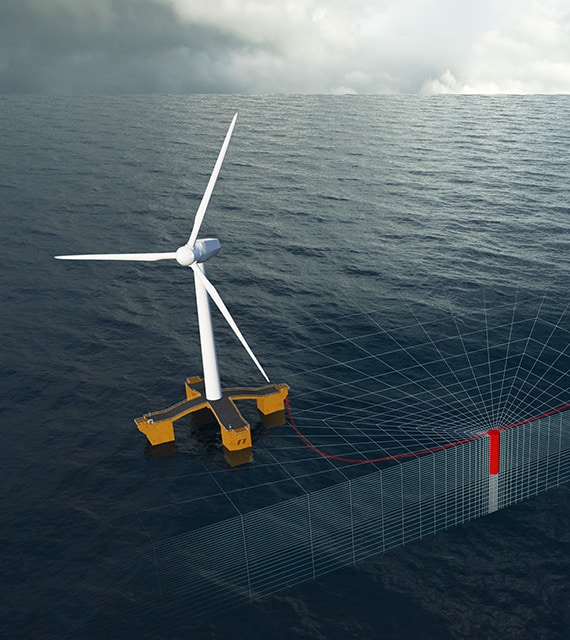
Mutualised anchors for offshore wind farms
Duration: 36 months (2021-2024)
Context
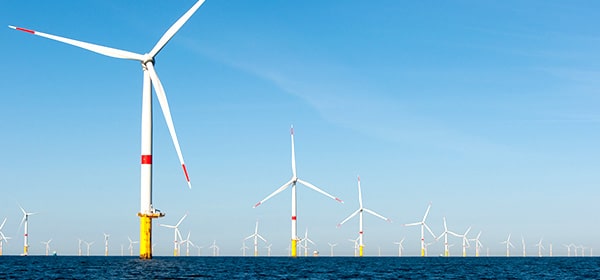
In Europe, around 80% of the offshore wind resource is located in waters more than 60 metres deep, where floating offshore wind turbines are seen as technologies capable of satisfying environmental constraints and ensuring a competitive levelized cost of energy. After the deployment of demonstrators and pilot farms, the next major stage is that of commercial wind farms, which raises the question of the morring systems to be used to ensure sufficient profitability.

Objective
To study the potential of shared anchors to reduce the levelized cost of energy for floating offshore wind farms
main achievements
- Assessment of the feasibility and cost, for different types of lines and water depths, of configurations involving shared anchors
- Definition of realistic anchor load cases using numerical analysis
- Development, validation and analysis of a finite element numerical model, coupled with an advanced constitutive soil model, representing a shared pile anchor under multidirectional and cyclic loads
- Centrifuge test campaigns for the study of a pile, in NE34 sand, under multidirectional and cyclic loadings
- Conclusions on the overall technical and economic performance of shared anchors
main outputs
- Databases:
- Multidirectional and cyclic anchor loadings
- Experimental campaign using a geotechnical centrifuge
- Numerical models:
- Hydro-servo-aero-elastic model of turbine + float + anchor system
- Finite elements model of the pile anchor in sand
- Global cost model
conclusion
MUTANC has shown that loads on shared anchors vary according to depth and type of mooring. It also appears that multidirectional and cyclic loadings on a pile in sand lead to variable displacements, which often increase with the intensity and directionality of the loads. Finally, the techno-economic analysis highlighted cost reductions of 16 to 33% when using shared anchors, validating the potential of such a solution applied to floating wind farms.
Ressources
Partners and funding
This project was led by France Energies Marines, Technip Energies and Saipem.


The total project budget was €1,343K.
This project received funding from France Energies Marines and its members and partners, as well as French State funding managed by the National Research Agency under the France 2030 investment plan. The project also has the financial support of Pays de la Loire region, Nantes Métropole and Pôle Mer Bretagne Atlantique.

Photo credit: Yohann Boutin